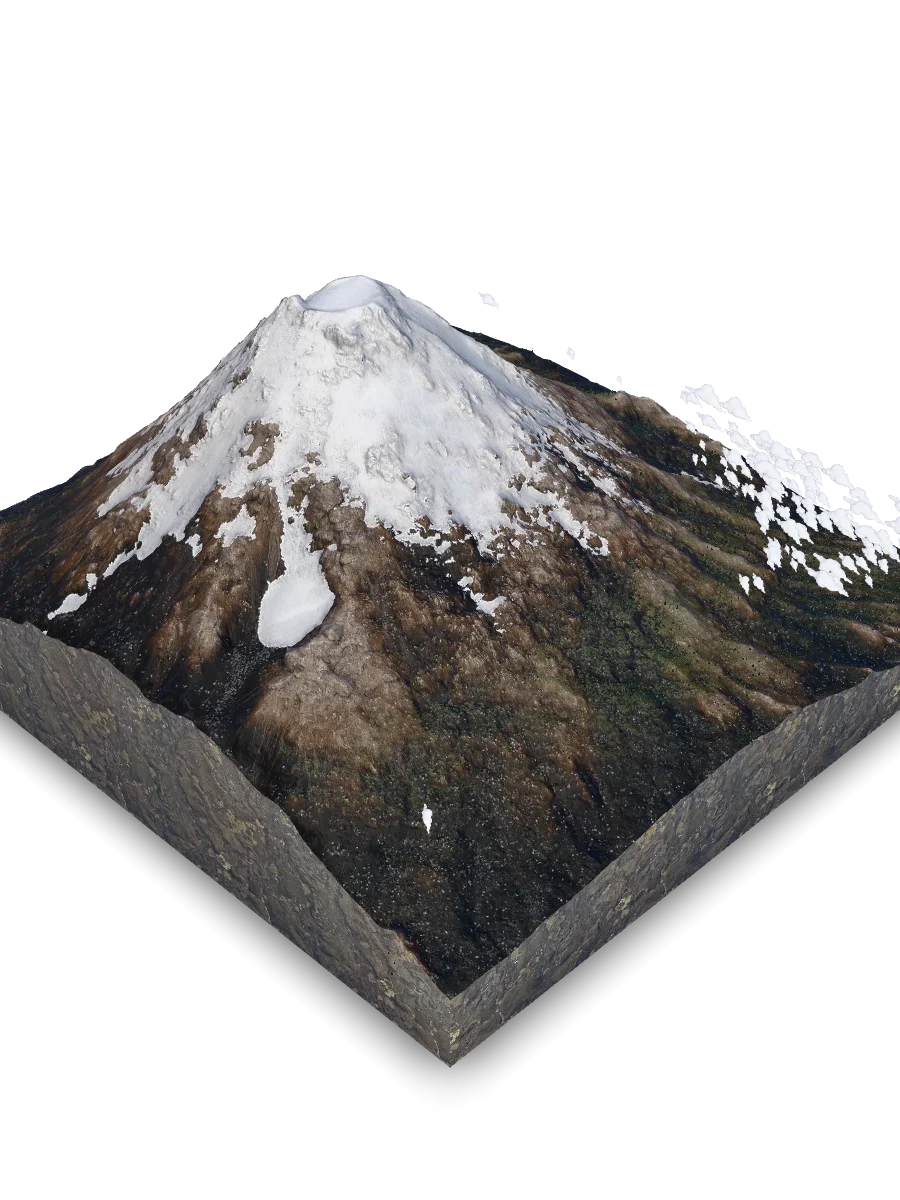
Mount Fuji (Fujisan), Japan
Explore Japan's 3,776-meter active volcano in 3D, from its summit crater to the Hōei craters formed by the eruption of 1707–1708.
Mount Fuji: The Sleeping Goddess
For centuries, pilgrims have braved the freezing void not for conquest, but for purification. Behind the postcard facade of eternal peace lies a restless, unpredictable spirit.
What drives pilgrims to endure pain and hypoxia on these merciless, ash-choked inclines?
How do we reconcile the two dramatically divergent faces of this global icon?
SYMBOL OF PEACE
The perfectly symmetrical, snow-capped cone inspired countless artists, establishing an international standard of aesthetic tranquility and eternal stillness.
IS MOUNT FUJI STILL ACTIVE?
Yes. Mount Fuji is an active stratovolcano, not an extinct one. Its last confirmed eruption was the Hōei eruption of 1707–1708, and Japanese agencies continue to monitor the volcano during its long quiet interval.
Where does the massive volume of melting snow, essential for life and rituals, vanish on this seemingly arid peak?
The highly porous volcanic rock instantly swallows surface moisture, funneling it into deep, invisible subterranean aquifers.
The Phantom Rains
- Deep Underground Infiltration: 90%
- Surface Retention and Evaporation: 10%
How Tall Is Mount Fuji?
At 3,776 meters, a jagged crown of hardened lava encircles a sheer, frozen crater. In this oxygen-starved void swept by violent thermal updrafts, extreme geology meets the divine. Pilgrims endure this brutal threshold to enter the mythical domain of the volcano goddess and touch the edge of the heavens.
Surviving the Black Desert
Pilgrims inevitably descend, retreating to the safety of the lowlands. But for the mountain's permanent residents, there is no escape. Above the clouds, oxygen thins and winds become invisible blades. Yet life refuses to surrender, clawing its way up the barren volcanic slopes.
How does a lifeless, frozen expanse of dark rock transform into a breathing ecosystem?
Does the mountain offer a uniform sanctuary, or is the landscape violently fractured?
THE DARK WOODS
Below the timberline, dense evergreen firs and golden larches forge a moss-draped sanctuary, sheltering elusive mountain antelopes and white winter stoats.
THE BARREN ZONE
Above the tree line, the biome collapses. Shrieking winds and shifting, razor-sharp rocks permit nothing but sparse patches of tough pioneer weeds to survive.
When summer finally arrives, does the high-altitude air offer a warm refuge for these resilient inhabitants?
Even during the warmest months, the thin atmosphere barely sustains temperatures above freezing.
Summer Thermal Dynamics
- July: 5.3 °C
- August: 6.4 °C
- September: 3.5 °C
The Hōei Eruption and Craters of 1707
The Hōei eruption began in December 1707 and continued into 1708, opening vents on Mount Fuji's southeastern flank and forming the Hōei craters. This barren scar breaks the mountain's symmetry and records its most recent confirmed eruption.
How Was Mount Fuji Formed?
Mount Fuji is an active stratovolcano on Honshu, built by repeated eruptions of basaltic lava and tephra in a complex subduction-zone setting. Its perfect geometric cone masks overlapping older volcanoes and a long history of growth, collapse, and renewal.
How did this flawless monolith rise from the chaos of colliding crusts?
Does this immense volume of lava build an indestructible fortress, or a fragile tower of sand?
ARMORED CORES
The dark, heavy ribbons of cooled lava act as a solid skeleton. These dense basalt formations fiercely resist the biting cold and wind, anchoring the colossal structure.
CRUMBLING ASH
Between the bedrock lies loose, gravel-like ash. Meltwater freezes here, shattering the surrounding stone and triggering sudden, massive rockfalls that constantly reshape the terrain.
Just how dramatically does the terrain pitch as you approach the towering summit?
The base offers a steady ascent, but the peak demands a grueling push up nearly vertical, unstable rubble.
Topographic Extremes
- Mountain Base (1486m): 26 degrees
- Summit Crater (3776m): 40 degrees
The Great Collapse
A colossal, unstable canyon violently carves into the western slope. This continuous landslide obliterates any encroaching vegetation, standing as a stark monument to nature's ongoing, destructive impermanence.
The Eternal Convergence
Mount Fuji is far more than a colossal monument of cooled basaltic lava or a grueling physical challenge. It is a living, breathing masterpiece where the violent reality of shifting tectonic plates and freezing storms directly shapes a fragile sanctuary for resilient subalpine forests and alpine wildlife.
Over centuries, this harsh arena of environmental extremes transformed into a sacred crucible for spiritual purification and artistic devotion. Ultimately, its perfect silhouette stands as a quiet reminder that even amidst the most destructive planetary forces, raw earth, fragile life, and the human spirit can forge an unyielding legacy.
Mount Fuji Facts & Quick Reference
Where is Mount Fuji and how tall is it?
Mount Fuji stands on Honshu, Japan, between Yamanashi and Shizuoka prefectures. Its summit reaches 3,776 meters above sea level, making Fujisan the highest mountain in Japan. The 3D model covers the upper cone from roughly 1,486 meters to the summit.
When did Mount Fuji last erupt?
Mount Fuji's most recent confirmed eruption was the Hōei eruption. It began in December 1707 and continued into 1708 from vents on the southeastern flank. The explosive eruption formed the Hōei craters and carried substantial ash as far as Edo, present-day Tokyo.
Is Mount Fuji still active, and will it erupt again?
Yes. Mount Fuji remains classified as an active volcano despite more than three centuries without a confirmed eruption. Another eruption is possible, but its timing cannot be predicted precisely; Japanese agencies therefore continue monitoring and volcanic-hazard planning.
How was Mount Fuji formed, and what type of volcano is it?
Mount Fuji is a dominantly basaltic composite stratovolcano built above older, overlapping volcanic edifices. Repeated lava flows created most of the younger cone, while explosive eruptions added layers of ash and other tephra. Together these episodes produced the steep, symmetrical profile visible today.
Mnemosyne Protocol
The 3D scan captures the shape, but misses the soul.
Upload your memory to preserve the feeling of this place.