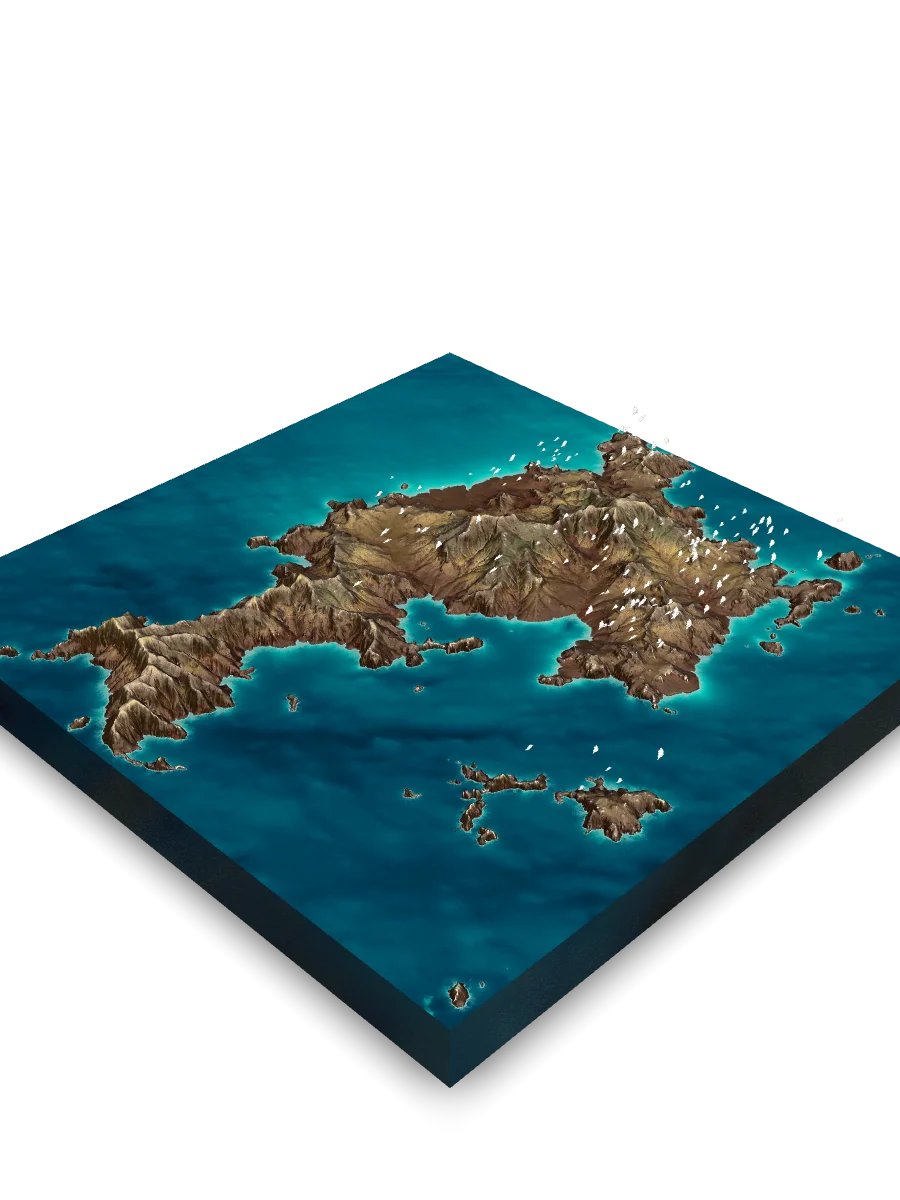
Komodo Island, Indonesia
Explore one of the principal islands of Komodo National Park in 3D, from dry savanna and monsoon forest to the natural habitat of the world's largest living lizard.
Where Is Komodo Island?
Komodo Island lies in East Nusa Tenggara, Indonesia, in the strait between Sumbawa and Flores. It is one of the three principal islands within Komodo National Park, alongside Rinca and Padar; the island itself is only one part of the much larger protected area.
On these sun-drenched, razor-sharp ridges, humanity does not rule supreme. Instead, villagers share narrow pathways with a three-meter prehistoric predator, bound by an ancient pact of twin kinship. This spiritual alliance has shielded the world's largest lizard from extinction for centuries.
How did this extraordinary coexistence between a lethal predator and isolated villagers endure for centuries without bloodshed?
The island's cultural landscape is shaped by two coexisting worldviews, demonstrating how ancient myth and modern science can converge on the exact same goal of preservation.
ANCESTRAL WORSHIP (PRAFU)
Indigenous villagers practice a deep-rooted system of ancestor worship, leaving offerings at sacred altars and ancient trees to harmonize the worlds of humans, dragons, and nature.
ARE KOMODO DRAGONS ENDANGERED?
Yes. The IUCN Red List classifies the Komodo dragon as Endangered. Komodo National Park protects its largest island populations, while fragmented distribution, low numbers, and projected habitat loss from sea-level rise remain long-term concerns.
For centuries, the islanders lived in complete isolation alongside their formidable neighbors. But once the outside world breached this prehistoric sanctuary, the Komodo dragon faced a new kind of threat: exploitation. Scientific discovery brought the dragons to the world’s attention long before their habitat received formal protection. It would take decades for recognition of the species to become recognition of the need to protect it.
Komodo Dragons on Komodo Island
Komodo Island is one of the species' main natural strongholds. The world's largest living lizard ranges through tropical savanna and monsoon forest from beach to ridge top, using burrows for shelter from the heat. Timor deer and wild boar move through the same dry lowlands and form important prey.
Where Do Komodo Dragons Live?
Wild Komodo dragons occur only in a small part of eastern Indonesia: Komodo, Rinca, Gili Motang, Gili Dasami, and parts of Flores. On Komodo Island, their habitat extends across dry savanna, deciduous monsoon forest, mangroves, and slopes from the coast toward the ridges.
Ascending from salt-sprayed shorelines to jagged summits, life morphs with elevation, dividing the island into three distinct, vertical ecological zones.
The archipelago's dramatic monsoonal climate drives a striking seasonal transformation, rewriting the visual texture and color palette of the entire landscape twice a year.
THE EMERALD DELUGE
From December to March, torrential monsoon rains spark an ecological explosion. Parched soils turn vibrant green, and dry, cracked ravines instantly transform into roaring torrents.
THE SCORCHED DROUGHT
For eight months, searing trade winds bake the hills. Grasslands turn to pale gold, while black fire scars pave the way for resilient fresh shoots in the next life cycle.
This vertical topography strictly dictates ecological boundaries, constraining where species can endure. How is the island's territory distributed among these specialized survival zones?
The proportional distribution of the dominant dry savanna and monsoon forest compared to other specialized oases.
Archipelago Biome Distribution
- Savanna & Monsoon Forest: 70% of the land area.
- Other Ecosystems (Mangroves & Quasi-Cloud Forests): 30% of the land area.
The Highland Oasis
Rising high above the arid lowlands is Gunung Ara, the island's highest summit at 808 meters. While the surrounding terrain bakes in a grueling eight-month drought, this peak performs an atmospheric miracle. Its elevation intercepts the condensation line, snagging low-hanging clouds on its jagged ridges. Here, specialized trees extract moisture directly from the daily fog, sustaining a hidden, emerald wonderland of mosses, ferns, and evergreen flora that could not survive anywhere else on this sun-scorched island.
The Tectonic Anvil
Beneath the thin, parched soil and golden grasslands lies a restless geological engine of colliding plates. This landscape is a fractured volcanic megastructure, forged in the Sunda Arc and sculpted by subduction: the slow, powerful collision where the oceanic crust dives beneath the continental plate.
By what geological sequence did these dramatic islands rise from the ocean to form the rugged, knife-edge peaks we see today?
When the monsoon deluge strikes this volcanic fortress, does the rock stand firm or disintegrate?
THE ANDESITIC SHIELD
Dense, heavy lava rock resists weathering. Forming the island's towering cliffs and craggy peaks, it acts as a sonic mirror, sharply echoing the howling trade winds and crashing surf.
THE ASHEN SPONGE
Porous layers of volcanic ash behave quite differently. They absorb torrential rains until they collapse in violent mudslides, and they swallow high-frequency sounds, casting an eerie, dead silence over deep gorges.
The primary sculptor of these jagged cliffs is not time, but the violent seasonal water cycle. How extreme is the precipitation shift that tests the island's volcanic integrity?
The terrain endures a dramatic weather whiplash, transitioning from a torrential monsoon deluge in January to an agonizing drought in August.
Extreme Monsoon Precipitation Shift
- January (Monsoon): 366 millimeters
- August (Drought): 10 millimeters
The Jagged Volcanic Spine
These dramatic ridges are the raw, visible scars of tectonic collision occurring miles beneath the ocean floor. Driven by the slow, powerful convergence of two massive plates, the seabed was buckled and thrust high above the waves. This steep, sun-scorched spine is regularly swept by intense dry-season grassfires, leaving behind scorched, pitch-black slopes. Yet, the moment monsoon rains arrive, these charcoal hills erupt into an undulating, brilliant sea of emerald grass, displaying an astonishing capacity for ecological rebirth.
The Code of the Primal Landscape
The volcanic foundation, the vertical ecosystems, and the mythic codes of the indigenous villagers are not isolated fragments. They are deeply intertwined. The physical geography directly sustains the survival of this legendary predator, while an ancient human culture acts as the ultimate shield for this delicate, timeless balance.
Komodo Island Facts & Quick Reference
Where is Komodo Island?
Komodo Island is in East Nusa Tenggara, Indonesia, within the Lesser Sunda Islands. It lies in the strait between Sumbawa and Flores and forms part of Komodo National Park. The 3D model covers the island and surrounding seafloor across an area measuring 40 by 40 kilometers.
Is Komodo Island the same as Komodo National Park?
No. Komodo Island is one of the principal islands inside Komodo National Park. The protected area also includes Rinca, Padar, numerous smaller islands, parts of Flores, and extensive surrounding marine waters. This page focuses on Komodo Island rather than the park as a whole.
Where do Komodo dragons live in the wild?
Their natural range is restricted to a few islands and coastal areas in eastern Indonesia. Wild populations occur on Komodo, Rinca, Gili Motang, Gili Dasami, and in parts of western and northern Flores. Komodo and Rinca hold the largest island populations within the national park.
What is the Komodo dragon's habitat on Komodo Island?
Komodo dragons use tropical savanna, deciduous monsoon forest, mangroves, and terrain from beaches to ridge tops. Dry lowlands provide burrows, open hunting ground, and prey including Timor deer and wild boar, while vegetation and elevation create cooler shelter during the hottest periods.
Are Komodo dragons endangered?
Yes. The IUCN Red List classifies the Komodo dragon as Endangered. Its naturally fragmented range and relatively small populations make the species vulnerable, while climate projections indicate that sea-level rise could reduce suitable habitat.
Mnemosyne Protocol
The 3D scan captures the shape, but misses the soul.
Upload your memory to preserve the feeling of this place.