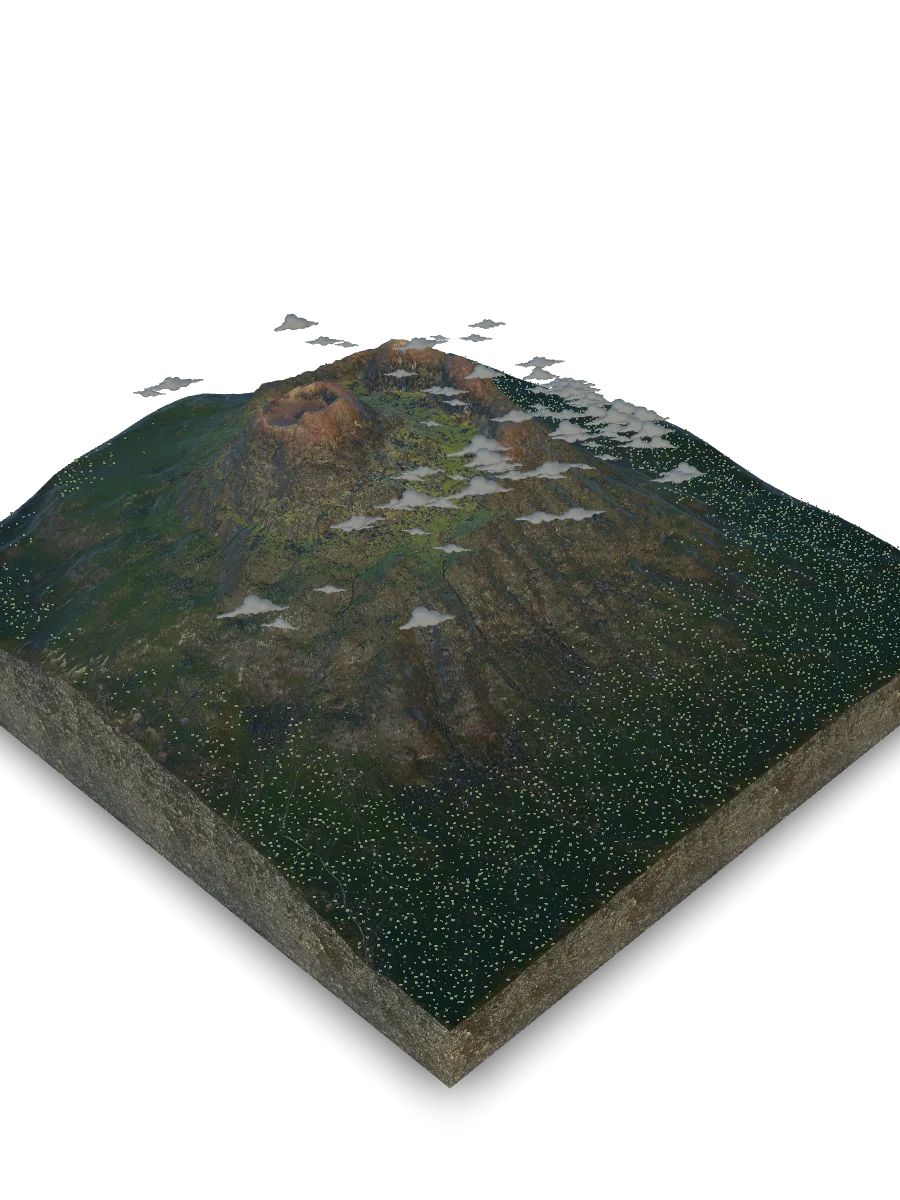
Mount Vesuvius, Italy
Explore the crater and Monte Somma caldera in 3D, from the AD 79 eruption that buried Pompeii to the most recent eruption in 1944.
The AD 79 Eruption of Mount Vesuvius
Mount Vesuvius is famous for the AD 79 eruption that buried Pompeii and Herculaneum beneath pumice, ash, and pyroclastic currents. Yet this engine of destruction also fuels phenomenal fertility and deeply rooted myth.
The eruption history of Mount Vesuvius extends far beyond AD 79. Major later eruptions included 1631 and 1906, and its most recent confirmed eruption ended in 1944. Vesuvius has remained quiescent but active and continuously monitored since then.
How did a single catastrophic event forge both the foundation of modern science and centuries of dark legend?
Has humanity viewed this terrifying power as a divine forge or a natural laboratory?
MOUNT VESUVIUS CRATER: THE DEMON'S ABYSS
For centuries, locals believed the crater was a gateway to the underworld. Legends speak of a cruel monk cast into the fiery pit by a phantom horse, and of Lucifer tearing away a piece of paradise, leaving this yawning chasm behind.
PLINY THE YOUNGER'S ACCOUNT
During the catastrophic eruption of AD 79, the Roman scholar Pliny the Younger meticulously documented the massive ash column that doomed Pompeii. His precise observations birthed modern volcanology by turning terror into data.
What forces red-hot avalanches and massive debris flows to pool in certain areas while obliterating everything in others? The answer lies not in absolute height, but in the mountain's extreme geometry. This brutal contrast in slope between the ancient wall, the young cone, and the valley floor dictates the very anatomy of a disaster.
Steep inclines leave no time for mature soil to form. Destructive masses plummet from the near-vertical caldera walls and the unstable cone, coming to rest only on the relatively flat valley floor, the single sanctuary where life gets a physical chance to take root.
Extreme Slope Geometry
- Inner Caldera Wall (Monte Somma): 75 degrees
- Gran Cono Slope (Active Cone): 35 degrees
- Valley Floor (Valle del Gigante): 5 degrees
Mount Vesuvius Crater and Great Cone
Reaching 1,281 meters into the sky, the main crater is a sheer, constantly crumbling bowl of black rock. Entirely devoid of trees, it is patrolled by hunting falcons-standing in human memory as the ultimate symbol of unpredictable natural wrath.
Resilience in the Ash
While human history here is measured in sudden tragedy, nature wages a slow, relentless siege on the scorched earth. Isolated from the main Apennine ranges, this volcanic island has become a sanctuary for resilient survivors fighting for every inch of ash.
How does a barren, solidified river of fire transform into a breathing forest?
Does the mountain offer equal shelter to all its inhabitants, or does the sun dictate rigid boundaries?
THE ARID SOUTH
Exposed to harsh sea winds and intense sunlight, the southern slopes of the young cone are arid and sparsely vegetated. Here, red foxes hunt wild rabbits among loose, shifting scoria.
THE HUMID NORTH
The shaded inner walls of the ancient caldera snag passing clouds, creating a cool, moist haven. Relict silver birches and rare orchids thrive here, sheltering the elusive garden dormouse.
Nature reclaims the scorched earth with surprising speed and diversity. But which group of creatures has been the most successful in conquering this harsh environment?
Insects and other small multi-legged creatures absolutely dominate the landscape, vastly outnumbering birds and mammals.
Animal Diversity
- Insects: 1200
- Birds: 150
- Mammals: 29
The Giant's Valley
This deep, arc-shaped depression sits at 800 meters, separating the ruined ancient caldera from the new cone. Choked with impenetrable thickets of golden broom, it acts as a silent, fertile witness to the legendary collapse that doomed antiquity's cities.
Mount Vesuvius Crater and Volcano Type
Mount Vesuvius is an active stratovolcano built inside the older Monte Somma caldera. Beneath a thin veil of vegetation and the ruins of ancient cities lies a nested geological machine where an ancient, shattered cauldron cradles a restless young cone.
What geological forces forged this massive, double-peaked structure into its distinct nested shape?
Is the mountain an unbreakable monolith, or a fragile tower of debris?
THE RIGID FRAMEWORK
Dark, heavy volcanic rock forms the unyielding skeleton of the mountain. These dense, solidified magma channels resist erosion, creating the sheer vertical cliffs that define the ancient cauldron.
THE CRUMBLING FOAM
Other parts of the mountain are built from lightweight, pumice-rich material. It shatters easily under pressure, creating shifting slopes prone to massive failure during storms.
Massive amounts of rainfall strike the volcano every autumn, yet not a single permanent stream exists on the upper levels. What hidden physical property allows this crumbling rock to swallow entire storms?
The porosity level reveals the truth: a significant volume of foam lava and tuff consists of vast empty voids, which instantly absorb water and drain the surface.
Porosity of Volcanic Layers
- Foam Lava (Cruma): 35%
- Volcanic Tuff: 25%
- Dense Tephrite: 12%
Monte Somma Caldera: The Ancient Shield
The sub-vertical walls of the ancient caldera form a jagged, protective horseshoe against the sea winds. Relict silver birches cling to its moist slopes, guarding the prehistoric legacy of an ancestral mountain that tore itself apart to build the landscape we see today.
The Pulse of the Mediterranean
This nested volcano is not merely a stack of cooling magma and fractured tectonic plates. It is a monumental hourglass, measuring the cycles of destruction and rebirth that have shaped the Italian coastline for millennia.
Far from a static monument, the mountain operates as an active, breathing ecosystem. It proves that no matter how violently the earth reshapes itself, the drive of both nature and humanity to rebuild from the ashes is equally unstoppable.
Mount Vesuvius Facts & Quick Reference
When did Mount Vesuvius erupt and destroy Pompeii?
The famous eruption occurred in AD 79 (79 CE). A towering Plinian column released ash and pumice over Pompeii. As parts of the eruption column collapsed, they generated deadly pyroclastic currents. The same eruption also destroyed Herculaneum and other settlements around the volcano.
When did Mount Vesuvius last erupt?
Its most recent confirmed eruption ended in April 1944. That eruptive episode included explosions, lava fountains, lava flows, ash fall, and evacuations. After 1944, Vesuvius shifted from an open-conduit eruptive state into its present quiescent phase.
Is Mount Vesuvius still active?
Yes. Mount Vesuvius remains an active volcano even though it is currently quiescent. Low seismicity and fumarolic activity have characterized the period since 1944, and the INGV Vesuvius Observatory continuously monitors the volcanic system. A future eruption is possible, but its date cannot be predicted precisely.
Where is Mount Vesuvius and what type of volcano is it?
Mount Vesuvius stands near Naples in Campania, southern Italy. Its Gran Cono reaches 1,281 meters above sea level. It is an active stratovolcano inside the partially preserved caldera of the older Monte Somma volcano, producing the nested Somma-Vesuvius structure visible in the 3D model.
Mnemosyne Protocol
The 3D scan captures the shape, but misses the soul.
Upload your memory to preserve the feeling of this place.