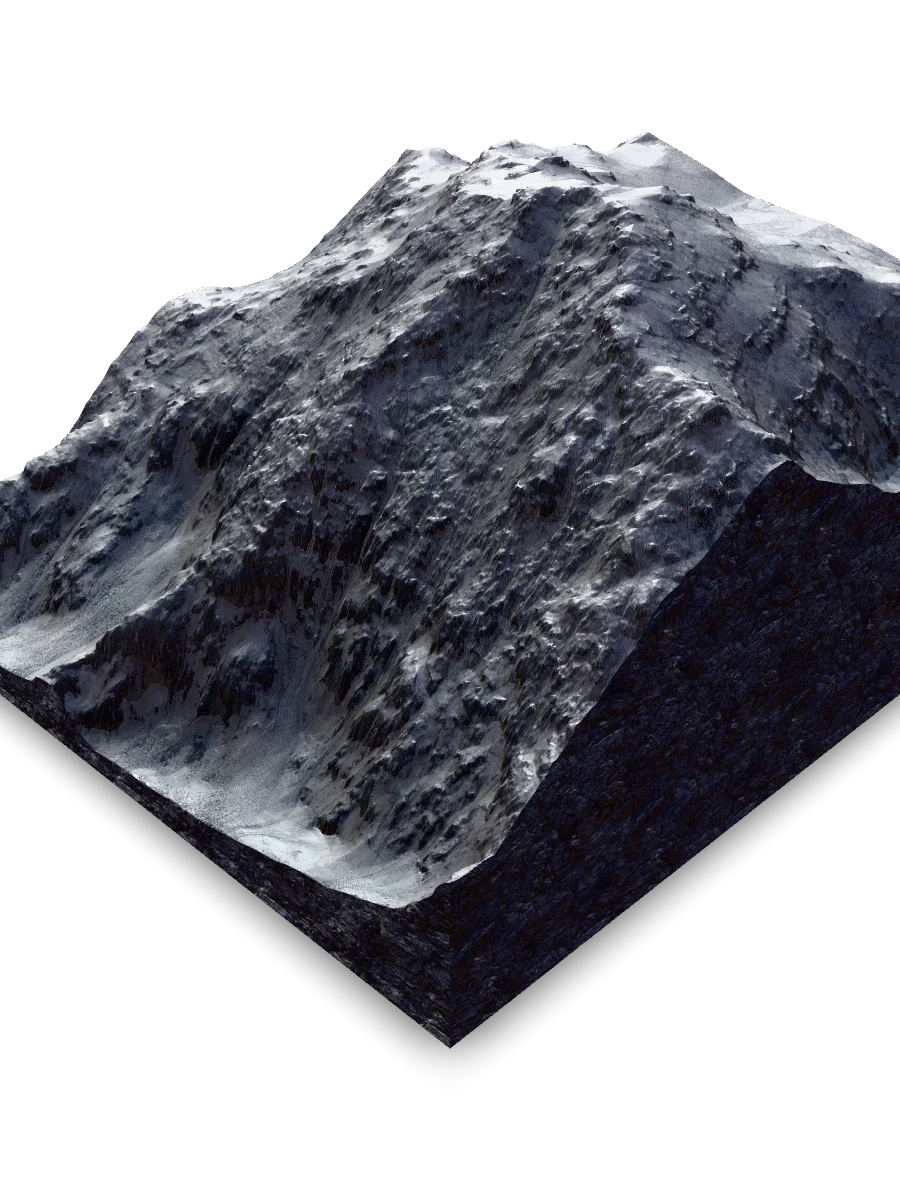
Denali (Mount McKinley), Alaska
Explore North America's highest mountain in 3D: a 6,190-meter peak in the Alaska Range shaped by tectonic uplift, the Denali Fault, and glaciers.
Denali and Mount McKinley: Why Two Names?
Denali is the mountain's widely used Koyukon-derived name; Mount McKinley is its current official federal name. Both identify the same Alaska peak, whose naming history joins Indigenous heritage, federal policy, and more than a century of exploration.
The history of the peak's conquest is a chronicle of courage, ambition, and tragedy. Each expedition contributed to the mountain's legend, from the first daring attempts to modern athletic achievements.
The mountain's name is a complex issue of federal and state jurisdiction. In 1975, the State of Alaska officially adopted the indigenous name "Denali". However, the federal government retained "Mount McKinley" until 2015, when it also adopted "Denali". This decision was reversed in 2025, when the federal name was officially returned to "Mount McKinley".
What Does Denali Mean?
Denali derives from the Koyukon Athabascan name Deenaalee, best translated as "The High One." It reflects a longstanding Indigenous connection to the mountain and has been the name recognized by the State of Alaska since 1975.
Why Was Mount McKinley Renamed Denali?
The federal government changed Mount McKinley to Denali in 2015 to recognize the longstanding Alaska Native name. Executive Order 14172 restored Mount McKinley for federal use in January 2025; the surrounding park remains Denali National Park and Preserve.
Each year, the mountain attracts more adventurers ready to challenge its harsh conditions. Its history of exploration is a chronicle of growing interest, marked by great achievements and tragic losses.
The climbing history of the mountain reflects a dramatic growth in interest. While only a few expeditions attempted the peak in the early 20th century, the total number of registered climbers per year grew from under 700 in the late 1970s to over 1,100 by 2000. Today, the mountain typically sees around 1,000 climbers attempt the summit each season, with a significant interruption in 2020 when no permits were issued.
How Tall Is Denali?
Denali's South Summit reaches 20,310 feet (6,190 meters) above sea level, making it the highest point in Alaska and North America. Walter Harper became the first member of the 1913 summit team to set foot on this highest point.
Denali: The Highest Mountain in North America
Denali stands in the Alaska Range of south-central Alaska. Its summit elevation of 6,190 meters and roughly 5,500-meter vertical rise create a multi-level environment where climate and landscape change dramatically from low taiga to permanent summit ice.
This altitudinal zonation represents a vertical journey through different natural zones, from dense forests to the arctic desert at the summit.
The Alaska Range, which contains Denali, serves as a powerful climatic barrier, creating two completely different environments to the north and south of the mountain.
North Slope: The Rain Shadow
Shielded from the moist Pacific winds. The climate here is more continental: dry, with cold winters and a warm, short summer. Continuous permafrost dominates the landscape.
South Slope: The Wet Front
Bears the brunt of the moist air masses. Precipitation is 2-3 times higher, the climate is milder, and glaciation is significantly more extensive. The snow line is lower here.
The resilience of the mountain's geological core is directly related to its mineral composition. The predominance of hard, crystalline minerals makes it extremely resistant to the destructive power of glaciers and weathering.
The mountain's core is composed of durable quartz monzonite. This chart illustrates a typical composition for this rock type, which requires 5-20% quartz. This quartz content ensures high resistance to erosion, while feldspars (Potassium and Plagioclase) are its most dominant minerals.
Wickersham Wall
A grand north face with a vertical rise of nearly 14,000 feet. Named after the judge who made the first ascent attempt, these cliffs are a legendary challenge.
How Was Denali Formed?
Denali formed through millions of years of terrane accretion, plate convergence, and uplift in the Alaska Range. Near the mountain, a bend in the active Denali Fault helps concentrate compression, while glaciers erode the surrounding valleys and preserve the massif's extreme relief.
The mountain's granitic core crystallized deep underground roughly 57 million years ago. Later tectonic uplift exposed this resistant rock, and continuing convergence and movement along the Denali Fault still raise the Alaska Range today.
McKinley's topography is defined by the sharp contrast between its core and the surrounding rocks. This confrontation between hard and soft material is the basis of its majestic appearance.
Granite Core
The central part of the massif is composed of strong, erosion-resistant quartz monzonite. This hard rock forms sheer walls and sharp peaks, withstanding the destructive force of glaciers.
Host Rocks
The granite intrudes into softer, older sedimentary and metamorphic rocks (flysch, schist). They are easily eroded by glaciers, which carve wide valleys at the base, enhancing the mountain's vertical rise.
This unique geological context creates one of the most impressive vertical rises on the planet. The mountain literally grows out of low plains, making it appear visually more massive than many other of the world's highest peaks.
Despite its lower absolute elevation, Mount McKinley's vertical rise from low plains (1,000-3,000 ft) significantly surpasses that of Mount Everest, whose base sits on the high Tibetan Plateau (17,000 ft).
North Peak
The second highest peak (19,470 ft). Historically notable for being climbed by the "Sourdough Expedition" in 1910, who erected a spruce pole near the top.
A Mountain as a Living System
Mount McKinley is not just the highest point of a continent, made of rock and ice. It is a living, pulsating arena where lithospheric plates collide, life desperately clings to the frozen ground, and the human spirit tests the limits of its capabilities. The physical strength of granite, the fragile beauty of the alpine forget-me-not, and the legends of ancient peoples are inextricably linked here.
It is in this synthesis of geology, biology, and culture that the true majesty of Denali is born. It is a reminder of how, against the backdrop of eternal planetary forces, fragile life and human history create their own unique, indivisible heritage.
Denali Facts & Quick Reference
Where is Denali, and what mountain range is it in?
Denali, currently named Mount McKinley for federal use, stands in south-central Alaska within Denali National Park and Preserve. It is the highest peak of the Alaska Range, a mountain chain that arcs across the state.
How tall is Denali, and is it the highest mountain in North America?
Denali's South Summit reaches 6,190 meters (20,310 feet) above sea level. This makes it the highest mountain in Alaska, the United States, and all of North America. Its lower North Summit reaches 5,934 meters (19,470 feet).
Why does the mountain have the names Denali and Mount McKinley?
Denali comes from the Koyukon name Deenaalee, meaning "The High One." Mount McKinley became the federal name in 1917, changed to Denali in 2015, and was restored for federal use in 2025. Alaska has officially used Denali since 1975, and the park remains Denali National Park and Preserve.
How was Denali formed?
Plate convergence and the accretion of crustal fragments built the Alaska Range over millions of years. Near Denali, compression around a bend in the active Denali Fault helps drive uplift. Resistant granitic rock preserves the high massif while glaciers cut deeply into the surrounding valleys.
Denali vs Everest: which mountain is taller?
Mount Everest has the higher summit elevation at 8,849 meters, compared with Denali's 6,190 meters. Denali, however, rises roughly 5,500 meters (18,000 feet) from the surrounding lowlands, giving it a greater base-to-summit rise in commonly used comparisons. The answer therefore depends on whether "taller" means elevation above sea level or vertical relief from the base.
Mnemosyne Protocol
The 3D scan captures the shape, but misses the soul.
Upload your memory to preserve the feeling of this place.