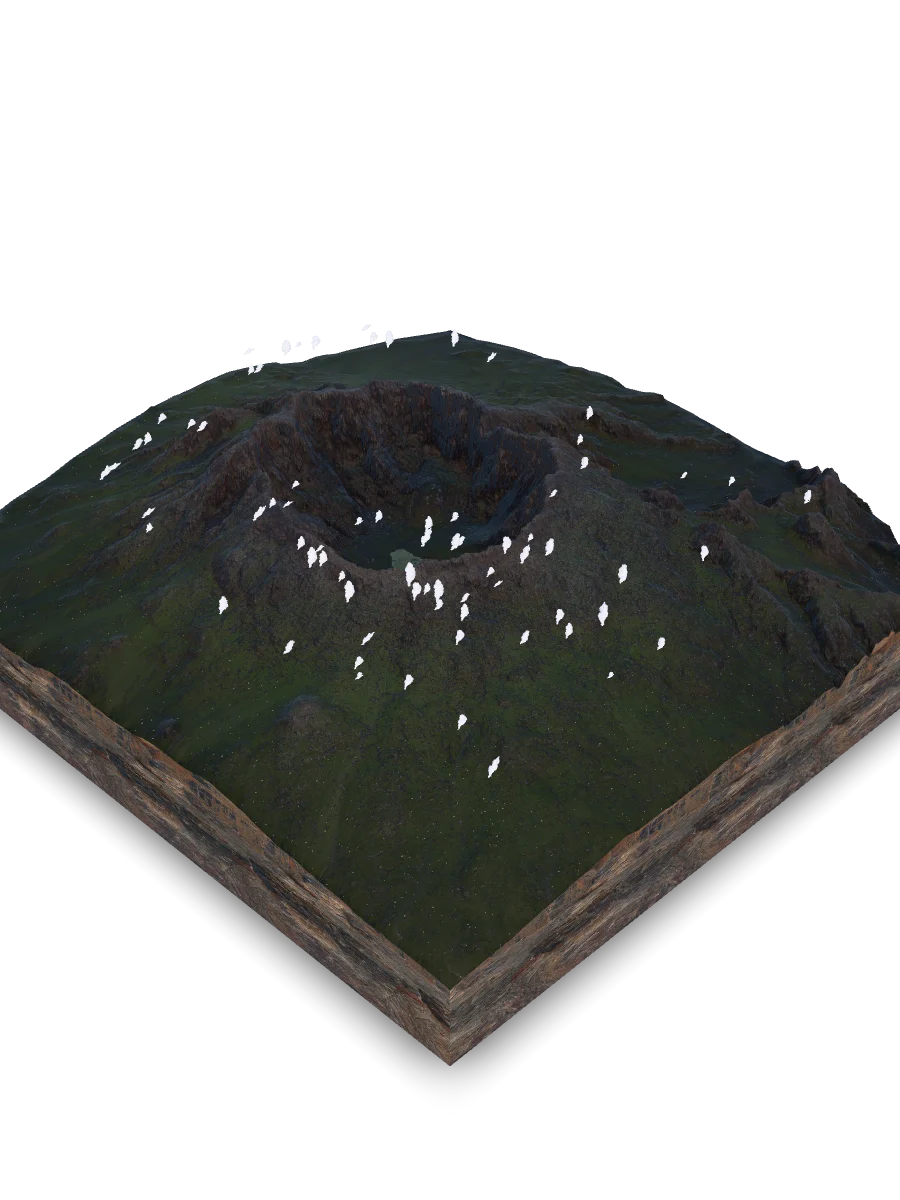
Mount Tambora, Indonesia
Explore the volcano whose 1815 eruption collapsed its summit into a six-kilometer caldera and helped cause the 1816 Year Without a Summer.
The 1815 Mount Tambora Eruption: The Giant That Shook the World
Mount Tambora's climactic eruption began on April 10, 1815, after a powerful explosive episode on April 5, and is classified as VEI 7. The eruption expelled a vast volume of magma and tephra; as the magma reservoir was partly evacuated, support beneath the summit was reduced and the volcano collapsed to form the present six-kilometer-wide caldera. Pyroclastic flows and ash devastated the surrounding region, while sulfur emissions contributed to global cooling and the 1816 Year Without a Summer, making this the largest recorded explosive eruption.
The deposits and present landform preserve a scientific sequence from stored magma to explosive eruption, caldera collapse, regional devastation, and global atmospheric effects.
Mount Tambora and the 1816 Year Without a Summer
The VEI 7 eruption injected sulfur-rich gases high into the atmosphere, where they formed aerosols that reduced incoming sunlight and disrupted weather far beyond Indonesia. The following year, 1816, became known as the Year Without a Summer, bringing severe cold, crop failures, and food shortages across parts of Europe and North America.
Local oral tradition and the archaeological record preserve different kinds of evidence about Tambora. The story of Sa'id Idrus is presented here as cultural memory, not as a scientific explanation for the eruption; the physical sequence is described in the timeline above.
ORAL TRADITION: SA'ID IDRUS
In the legend, Haji Sa'id Idrus rebukes Tambora's ruler after finding a dog in a mosque. The ruler deceives him into eating dog meat and orders his execution after the scholar condemns the act. The story interprets the eruption as divine retribution for the killing.
THE POMPEII OF THE EAST
Geoarchaeological work begun in 2004 used ground-penetrating radar and excavation to document a settlement beneath the 1815 deposits. Researchers reported carbonized building materials, artifacts, and human remains, inspiring the comparison "Pompeii of the East."
Mount Tambora Before and After the 1815 Eruption
How did this massive collapse reshape the giant that once dominated the regional horizon?
This chart illustrates the sudden loss of nearly a third of the mountain's elevation in April 1815. The towering summit, which once rivaled the tallest peaks of the Indonesian archipelago, was replaced by the vast, six-kilometer-wide caldera visible in the 3D model.
Mount Tambora Height Before and After the 1815 Eruption
- Before eruption: 4,300 m
- After eruption: 2,850 m
The Pompeii of the East
On the volcano's northwestern flank, the 1815 deposits preserve traces of a buried settlement. Ground-penetrating radar and excavation documented carbonized building remains, artifacts, and human remains beneath pyroclastic deposits, giving the site its "Pompeii of the East" comparison.
The Emerald Staircase
While human kingdoms vanished in days, the quiet forces of nature immediately began reclaiming the scarred slopes. Today, Tambora stands as a living emerald staircase, with each altitudinal zone marking a distinct chapter of ecological resilience.
How does life ascend a slope choked by sterile ash and volcanic gasses? The ecological colonization of Tambora is a vertical saga of adaptation, with distinct pioneer species claiming territory at specific elevations to survive thin air and relentless monsoons.
This ecological rebirth is not a peaceful transition, but a fierce struggle between rapid grass invasions and the slow return of primary forests: a tension that shapes the volcano's modern slopes.
THE ALANG-ALANG GRASSLANDS
These vast, monocultural grasslands surged across the slopes after pyroclastic flows destroyed the native forests. While they stabilize loose ash and prevent erosion, their dense, matted root systems choke out germinating tree seeds.
NATURE’S ENGINEERS
Timor deer and long-tailed macaques act as ecological engineers. Migrating across elevations, they carve pathways through the dense grass and deposit the seeds of pioneer trees, slowly breaking the grassland monopoly and helping the forest climb back.
Yet, how does this harsh microclimate interact with changing elevations? And how do temperatures swing between the tropical coast and the subalpine rim across the changing monsoons?
This atmospheric profile reveals a steep thermal gradient: warm tropical lowlands give way to subalpine summit temperatures, shaping the intense wind patterns that sculpt the asymmetrical 'flag' crowns of Casuarina trees.
Altitudinal Temperature Gradient
- Base (377m) - Wet Monsoon: 28°C
- Base (377m) - Dry Monsoon: 26°C
- Summit (2850m) - Wet Monsoon: 9°C
- Summit (2850m) - Dry Monsoon: 8°C
The Howling Rim
Perched at a breathtaking altitude of 2,850 meters, the jagged basaltic ridges of the caldera rim act as a colossal acoustic instrument. When fierce monsoons strike, winds rushing through these stone teeth transform into a piercing, high-frequency howl. On these barren slopes, solitary Cemara gunung trees twist and warp under the raw power of the elements. These cliffs also form the setting for the Sa'id Idrus oral tradition, a cultural story about the disaster rather than an account of its geological cause.
The Magmatic Pipeline: Geology of Mount Tambora and Its Caldera
Beneath the fragile forest floor and the transient nesting grounds of birds, a world of immense, crushing power shapes the deep Earth. This is the realm of plate collision, where the ocean floor plunges downward at several centimeters per year. This violent subduction zone melts the mantle wedge, feeding a complex, two-tiered magmatic plumbing system that remains one of the most volatile volcanic furnaces on our planet.
How does ocean water dragged into the mantle transform into a cataclysmic surface explosion? The pathway of Tambora's magma is a vertical pipeline of extreme heat and pressure.
The catastrophic collapse did not produce a uniform stone desert: instead, it exposed two highly contrasting geological zones of vastly different mechanical strength.
SOLID LAVA SHIELD
Massive trachyandesite (a potassium-rich, dark gray volcanic rock) possesses colossal compressive strength. These durable flows form the sheer vertical walls of the caldera, resisting erosion and fracturing only into massive blocks.
UNCONSOLIDATED ASH BLANKET
Unconsolidated pumice fall and loose ash horizons have virtually zero cohesion. Tropical downpours instantly wash them away, triggering destructive debris flows (lahars) that carve deep, flat channels completely devoid of soil or vegetation.
Can a planetary giant completely alter its internal architecture over hundreds of thousands of years? How many volcanic cycles did this mountain endure before its modern, shattered silhouette took its final form?
This timeline charts the evolutionary history of Mount Tambora, tracking its dramatic transformation from a gentle effusive shield to a towering, highly explosive stratovolcano.
Evolutionary epochs of Mount Tambora
- Effusive shield period (190,000 to 86,000 years ago): 104,000 years
- Explosive stratovolcanic period (86,000 to 4,000 years ago): 82,000 years
- Late Holocene pre- and post-caldera period (last 4,000 years): 4,000 years
The Ephemeral Mirror
At the flat floor of the colossal, 1,250-meter-deep caldera, an otherworldly sight takes shape. During the wet monsoon, an ephemeral freshwater lake forms, trapping a rare suspension of microscopic silica dust. While resilient Javanese edelweiss stubbornly claws its way up the sheer caldera scarps, local communities look down into this void with deep spiritual awe. They also associate the caldera with the Sa'id Idrus oral tradition described earlier. That legend gives the landscape cultural meaning; the caldera itself formed through volcanic eruption and collapse in 1815.
The Ultimate Crucible
Tambora is ultimate proof of our interconnected world, showing how a single geological event can instantly rewrite global climate, disrupt nature, and alter the destiny of civilizations thousands of miles away.
Mount Tambora Facts & Quick Reference
Where is Mount Tambora and what type of volcano is it?
Mount Tambora is an active stratovolcano on the Sanggar Peninsula of northern Sumbawa Island, Indonesia. Its summit reaches 2,850 meters around a six-kilometer-wide and roughly 1,250-meter-deep caldera formed by the 1815 eruption. Before that collapse, the volcano rose to an estimated elevation of about 4,300 meters.
Why are eruptions at Mount Tambora so violent and explosive?
The immense volatility of Mount Tambora stems from complex tectonic subduction processes. The Indo-Australian plate drives beneath the Sunda Plate at 6 to 7 centimeters annually, dragging ocean water 180 kilometers deep where intense pressure releases it into the hot mantle. This moisture lowers the mantle's melting point, creating a gas-rich alkaline melt that pools in a shallow chamber between 2.3 and 7.5 kilometers deep. This continuous accumulation of volatile gases builds the immense pressure required to trigger global climate-altering events.
Have archaeologists found evidence of settlements destroyed by Tambora?
Geoarchaeological surveys and excavations at Tambora Village documented houses and artifacts buried beneath deposits from the 1815 eruption. Researchers used ground-penetrating radar to map structures and excavated carbonized building materials, household objects, and human remains. These findings show that a settlement was destroyed and rapidly buried by the eruption; "Pompeii of the East" is a descriptive comparison rather than the formal name of a proven lost civilization.
Mnemosyne Protocol
The 3D scan captures the shape, but misses the soul.
Upload your memory to preserve the feeling of this place.