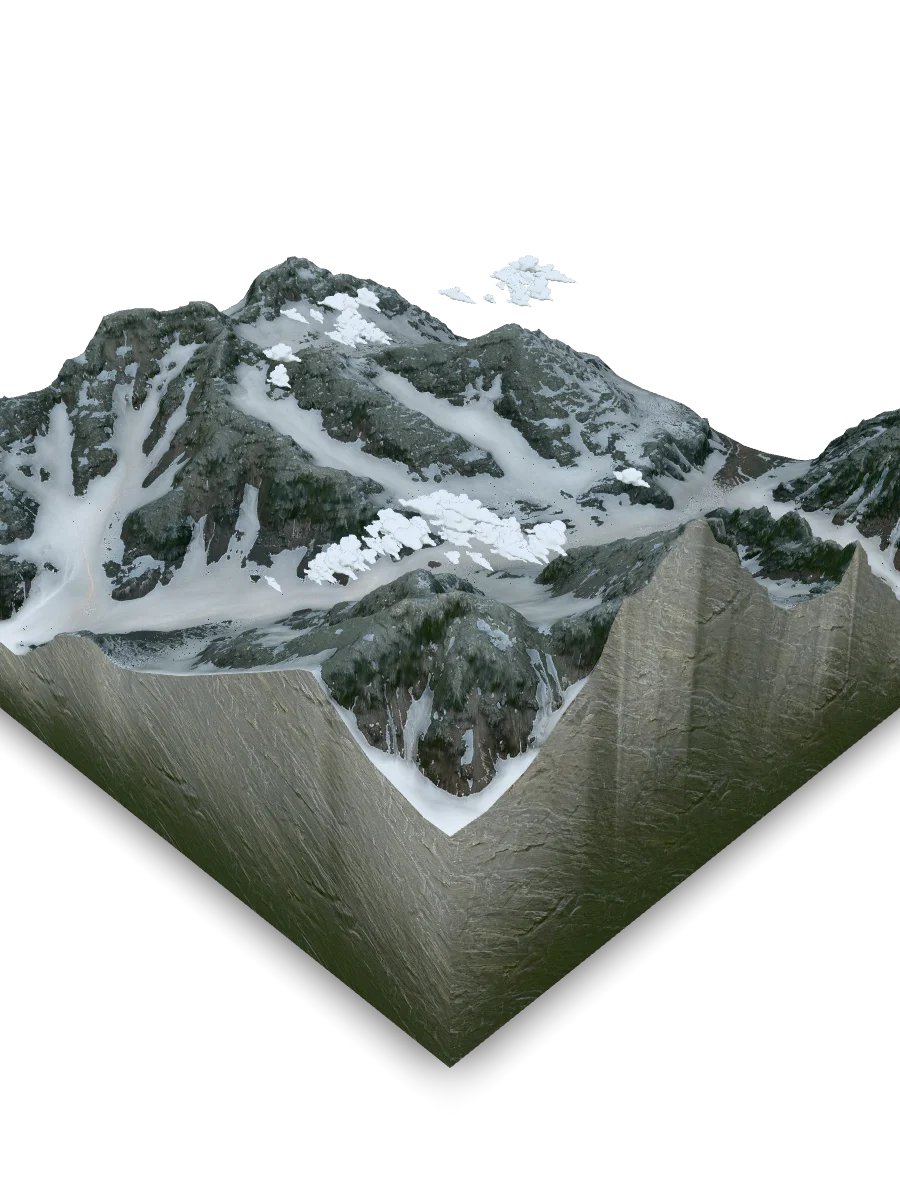
Brenner Pass: Alpine Pass Between Austria and Italy
Explore a 3D map of Brenner Pass in the Eastern Alps, where a low mountain saddle links Austria and Italy across one of Europe's major north-south corridors.
Where Is Brenner Pass?
Brenner Pass lies in the Eastern Alps on the border between Austria and Italy. It connects Austrian Tyrol to South Tyrol in northern Italy, with Innsbruck to the north and Sterzing/Vipiteno to the south. The 3D map places the international crossing within the surrounding ridges and valleys.
Brenner Pass Elevation
The saddle is approximately 1,370 metres above sea level. Its relatively low elevation and broad north-south approach help explain why roads, railways and earlier routes converged here instead of on the higher terrain nearby.
The Crossroads of Empires
A subtle dip in the jagged horizon, this mountain saddle served as the bottleneck through which the fate of empires was poured. For millennia, the rise and fall of civilizations hung on a single question: who controlled this deceptively simple passage through the Alpine wall?
The Brenner Pass presents a striking geographical paradox: while surrounding summits tower above 2,600 meters, the saddle drops to just 1,370 meters. This deep indentation provides a remarkably gentle, flat valley floor, creating an irresistible natural gateway. More than a simple trail, it became the vital artery connecting Northern Europe's Germanic, Scandinavian, and Baltic worlds with the Mediterranean's classical civilizations. For millennia, global powers fought to choke or open this bottleneck, a place where the ambitions of kings, emperors, and generals decided the fate of millions.
While the pass served as a conduit for commerce and culture, it also functioned as a formidable barrier for defense and taxation, sparking a perpetual struggle between bridge and border.
THE TOLL CASTLES
Local rulers, most notably the medieval Counts of Tyrol, recognized the pass as an economic goldmine. They fortified toll stations and garrisoned imposing strongholds like Reifenstein Castle, built by the Bishops of Brixen in the eleventh century, along the narrow valley walls. This transformed the natural gateway into a series of lucrative, heavily armed fiscal checkpoints.
THE PILGRIM ROAD
In stark contrast to these militarized checkpoints, the pass also welcomed the peaceful, spiritual journeys of the Via Romea Germanica. Documented in 1236 by Abbot Albert of Stade, this historic trail guided thousands of pilgrims through the Alpine valleys, carrying art, ideas, and cultural traditions across the great mountain divide.
Road and Railway Across Brenner Pass
The modern Brenner Pass route remains a surface corridor. The A13 and A22 motorways meet at the Austria-Italy border, while the Brenner Railway climbs across the same Alpine saddle. Both follow the low north-south opening used by earlier roads, reinforcing the pass's long-standing role as a geographic crossing.
When we map two millennia of continental logistics on a single timeline, the distribution of these transport networks reveals an unexpected pattern punctuated by massive chronological gaps. Do these long silences indicate an abandoned pass, or do they expose the tragic breakdown of central administrations? More importantly, which of these transit systems managed to withstand geopolitical pressures and dictate the flow of European history for the longest span of time?
This timeline reveals a profound historical paradox: while modern high-speed networks seem permanent, the medieval road system governed transit across the Brenner Pass for the longest uninterrupted period. Conversely, the prominent gaps mark the collapse of centralized authority, when paved highways degraded back into unmanaged dirt tracks.
Dominant Logistical Infrastructure Lifespans
- Roman Highway (Via Raetia Era): 100 to 500 [Duration: 400 years]
- Medieval System (Via Imperii Framework): 806 to 1490 [Duration: 684 years]
- Carriage Road (Stagecoach Hegemony): 1777 to 1867 [Duration: 90 years]
- Imperial Railway (Brennerbahn Era): 1867 to present [Ongoing]
Brenner Pass and the Brenner Base Tunnel
The Brenner Base Tunnel is not the mountain pass or its existing railway. It is a separate 55 km, low-gradient railway tunnel beneath the Alps between Innsbruck in Austria and Fortezza in Italy. Its highest point lies about 580 metres below the Brenner Pass, distinguishing the underground route from the surface crossing shown here.
The March of Barbarossa (1154 CE)
Across this windswept mountain saddle, where Alpine frost shatters the surrounding ridges and ancient Swiss stone pines cling to the scree, Holy Roman Emperor Frederick I Barbarossa marched his imperial army into Italy in 1154 CE. Traversing this critical high-altitude corridor, Barbarossa made his way toward Rome for his imperial coronation, securing one of medieval Europe's most vital strategic pathways.
Brenner Pass in the Alps: Life by Elevation
While kings and merchants marched across the pass, leaving only fading ruts in the stone, an older, quieter struggle unfolded on the slopes above. Here, in the shadow of imperial highways, specialized plants and animals brave a fierce climate along a rapid vertical gradient, where every hundred meters of elevation demands radical survival strategies.
The ecosystems of the Brenner Pass are defined by stark vertical zones. As the landscape climbs from the valley floor to alpine summits, vegetation gives way to highly stratified bands, resembling a multi-tiered ecological skyscraper. Each zone is populated by specialized species that have evolved to cope with steep slopes, nutrient-poor soil, and biting mountain winds.
The local wildlife is similarly divided between specialized dwellers of the high rock faces and industrious architects of the alpine meadows.
THE CLIFF-DWELLERS
Alpine chamois and ibex patrol the sheerest rock faces between 1,500 and 2,600 meters. The chamois is equipped with specialized hooves featuring a soft, rubbery inner pad for traction on wet rock slabs and a hard outer rim to grip microscopic ledges, allowing them to evade predators with effortless vertical leaps.
THE SOIL ARCHITECTS
On the open meadows above the timberline, alpine marmots build deep, sprawling networks of underground tunnels. Their intensive burrowing acts as a powerful geomorphic force, mixing soil layers and pushing unweathered rock to the surface, forming mounds that physically reshape the high-altitude landscape.
This high-altitude flora undergoes a dramatic transformation with the turning of the seasons. As the Alpine climate shifts, the entire landscape experiences a profound visual metamorphosis. How does this vegetative canopy coordinate its color palette across these seasonal boundaries?
This chronological matrix tracks the dominant color shifts of the Brenner Pass vegetation, demonstrating how the ecosystem occupies precise seasonal niches, from the bright lime-green of spring larches to the dark conifers of winter.
Biome Color Matrix
- Winter Latency (Conifers & Snow): January to April, November to December [HEX: #1E2F23]
- Spring Awakening (Larch & Beech Foliage): May to June [HEX: #70A288]
- Summer Bloom (Peak Alpenrose Explosion): July to August [HEX: #C1121F]
- Autumn Gold (Deciduous & Larch Transition): September to October [HEX: #D4A373]
Goethe's Italian Journey (September 1786)
In September 1786, Johann Wolfgang von Goethe traversed this mountain pass during the opening stage of his historic Italian journey. Following the newly constructed Habsburg road, he crossed not just a political frontier, but a symbolic boundary between two cultural worlds. In his memoir, *Italian Journey*, this once-fortified Alpine passage became the meeting point of North and South, where Germanic traditions dissolved into the classical heritage of the Mediterranean. Through Goethe's pen, the Brenner Pass secured an enduring place in the European cultural imagination.
Terrain of the Brenner Pass
The survival of these fragile alpine forests and meadows is dictated by the monumental, shifting forces locked deep within the stone. Beneath the green canopy lies a restless underworld of grinding tectonic plates and high-speed winds that continually sculpt this historic gateway.
How did a massive normal fault, which typically tears landscapes apart, end up carving the deepest and most accessible natural passageway across the Alpine chain?
This dynamic geology produces a highly asymmetric landscape, pitting fragile, crumbling metamorphic sheets against the unyielding crystalline core of the Alps.
THE FRAGILE SHIELD
The western slopes are dominated by Innsbruck quartz-phyllite, a fine-grained metamorphic rock that easily splits into paper-thin plates. Because these slick sheets have exceptionally low shear strength, water-saturated slopes frequently trigger landslides and earthflows, exposing fracture lines stained with rust-orange iron oxides.
THE CRYSTALLINE GIANTS
East of the active fault lies a massive footwall composed of Central Gneiss, an exceptionally hard crystalline rock. Resistant to chemical weathering, these ancient granites degrade primarily through frost-wedging along widely spaced joints, collapsing into massive rectangular blocks that form the region's highest, most stable summits.
How does the airflow of the Brenner Pass transform from a gentle valley breeze into a violent storm during Föhn events?
During a South Föhn event, the narrow valley acts as a giant aerodynamic funnel, accelerating routine mountain breezes into hurricane-force gusts.
Brenner Pass Wind Speed Progression
- Prevailing Winds: 15 km/h
- Active Föhn Winds: 150 km/h
- Peak Hurricane-Force Gusts: 200 km/h
The Föhn Wall
During a Föhn event, a sharp pressure gradient develops across the Alps, driving moist air toward the Brenner Pass. As this air rises along the southern slopes, it cools and condenses into a dramatic cloud barrier known as the Föhn Wall. The pass acts as a natural funnel, accelerating the airflow through the narrow mountain gap. Descending the northern slopes, the air warms and dries rapidly due to compression. Consequently, a gentle valley breeze can transform into a scorching, gale-force wind capable of melting snowpacks and sparking severe wildfire conditions.
Brenner Pass Map in 3D
This 3D map places the Brenner Pass saddle, surrounding Alpine ridges and north-south approaches in a single spatial view. The terrain explains why roads, the existing railway and centuries of earlier routes converge on this relatively low crossing between Austria and Italy.
Brenner Pass Map, Location & Elevation Facts
What is Brenner Pass?
Brenner Pass is a mountain pass in the Eastern Alps and a major north-south crossing used by roads and the Brenner Railway. Its saddle lies on the international border between Austria and Italy.
Where is Brenner Pass?
Brenner Pass is in the Eastern Alps between Austrian Tyrol and South Tyrol in northern Italy. Innsbruck lies to the north, while Sterzing/Vipiteno lies to the south.
What countries does Brenner Pass connect?
Brenner Pass connects Austria and Italy. The border crosses the saddle between the Austrian state of Tyrol and the Italian autonomous province of South Tyrol.
What is the elevation of Brenner Pass?
Brenner Pass is approximately 1,370 metres (4,495 feet) above sea level. That is low relative to many surrounding Alpine ridges and helps make the pass an accessible north-south corridor.
Why is Brenner Pass important?
Its comparatively low saddle provides a direct route through the Eastern Alps. Roads, the Brenner Railway and older trade and military routes have used this crossing to connect northern and southern Europe.
Is the Brenner Base Tunnel the same as Brenner Pass?
No. Brenner Pass is the surface mountain saddle and the route of the existing road and railway crossing. The Brenner Base Tunnel is a separate 55 km railway tunnel beneath the Alps between Innsbruck, Austria, and Fortezza, Italy.
Mnemosyne Protocol
The 3D scan captures the shape, but misses the soul.
Upload your memory to preserve the feeling of this place.