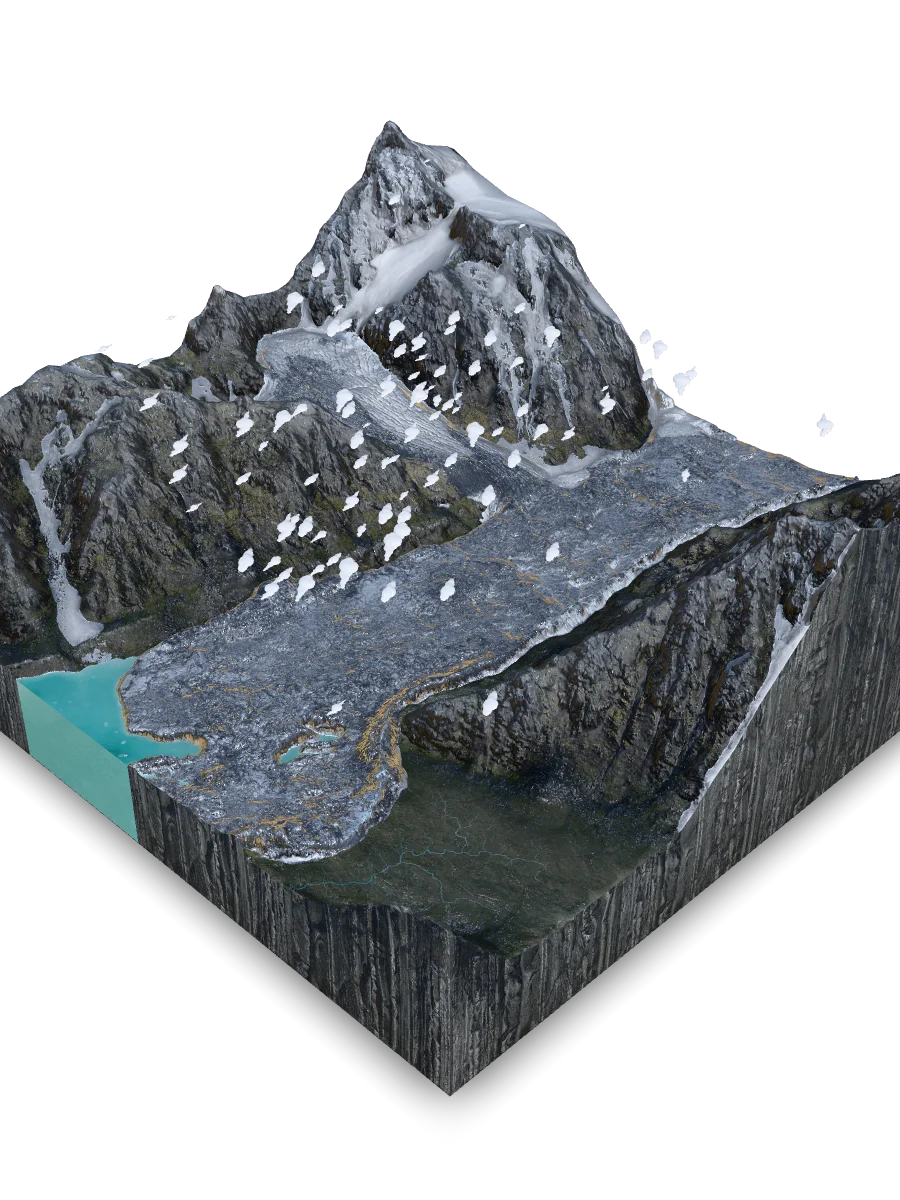
Tasman Glacier (Haupapa), New Zealand
Explore New Zealand's largest and longest glacier in a 3D map of Aoraki/Mount Cook National Park. Follow its debris-covered tongue to Tasman Lake, where retreat and iceberg calving are reshaping the valley.
Where Is Tasman Glacier?
Tasman Glacier is located in Aoraki/Mount Cook National Park in Canterbury on New Zealand's South Island. It flows through the eastern side of the Southern Alps into Tasman Lake and the Tasman River system.
For centuries, the frozen peaks of the Southern Alps stood as silent stone sentinels guarding the edge of the known world. Yet beneath their icy shrouds lies a living narrative: sacred Māori lore and daring alpine conquests have carved an indelible human imprint into the very breath of the glacier.
How did these massive, ice-draped peaks transform from celestial gods of ancient lore into the ultimate testing ground for human endurance and alpine science?
Do these two perspectives, the deeply spiritual ancestry of the Māori and the bold exploration of Western geographers, clash, or do they share a deeper connection?
The Inviolable Peaks
To Ngāi Tahu, the landscape is a living family tree. The peaks hold sacred "Tōpuni" status, securing legal recognition of their spiritual importance. Scaling the actual summit is viewed as a violation of these sacred boundaries, emphasizing a deep reverence for the mountain's natural water cycles.
The Vertical Proving Ground
For generations of mountaineers, this valley has been the ultimate testing ground. Here, early surveyors mapped massive, uncharted ice systems, and legendary climbers honed their vertical survival skills on crevasse-riddled ice cliffs.
Tasman Lake and the Retreat of Tasman Glacier
Tasman Lake began forming at the glacier terminus in 1974. Long-term thinning and retreat exposed open water, and contact with the deepening lake then enabled thermal undercutting and iceberg calving to accelerate changes at the glacier front.
Published measurements show Tasman Lake expanding from 0.56 km² in 1982 to 5.96 km² in May 2008. The growing proglacial lake records the retreat of the Tasman Glacier terminus, but lake growth is not itself a measurement of annual ice melt.
Tasman Lake Surface Area Growth
- 1982: 0.56 square kilometers
- 1995: 2.35 square kilometers
- 2000: 3.21 square kilometers
- 2005: 4.70 square kilometers
- 2008: 5.96 square kilometers
Ball Glacier: The High Refuge
This prominent tributary glacier originates in a deep, bowl-shaped rock depression: a glacial cirque flanked by sharp, jagged ridges known as arêtes. Along its rugged moraine margins and stable stone slopes, rare rock wrens find crucial nesting refugia within boulder fields, sheltering from fierce alpine storms. Meanwhile, the inquisitive kea, the world's only alpine parrot, searches for food across the open, high-altitude slopes. The changing confluence where this ice stream meets the main valley floor has been a focus of scientific photographic monitoring since 1904, serving as a historic landmark along the classic route to the high pass.
The Alpine Outposts
While we map the ranges and write our histories, a far older struggle for survival plays out across the vertical boundaries of this landscape. From the valley floor to the nival summits, unique plants and resilient wildlife endure hurricane-force winds and volatile temperatures on bare stone.
How does life organize itself across the steep climatic zones of the valley, ascending from the proglacial lakebed to the frozen heights?
On the high glacier snowfields, a striking summer anomaly occurs. Mass blooms of specialized, microscopic single-celled algae (primarily Chlainomonas kolii and Chlamydomonas nivalis) stain the melting snow in pinkish-red streaks, producing a natural carotenoid pigment that acts as a biological shield against extreme ultraviolet radiation.
Is this specialized alpine ecosystem protected by its remote isolation, or does it face an unprecedented, multi-front threat from invasive species?
The Alpine Originals
The mischievous, olive-green kea acts as a dynamic geological force, tearing up alpine sod in search of grubs. Alongside it, the tiny, elusive rock wren survives entirely above the treeline, nesting inside deep cavities between unstable moraine boulders to shield its chicks from mountain storms.
The Introduced Threat
Introduced pests disrupt this delicate balance. Himalayan tahr and chamois graze high-altitude slopes bare, triggering severe erosion, while self-sown wilding pines creep up the valley floor, slowly overtaking native golden tussock grasslands.
Across the Southern Alps, end-of-summer snowlines vary from year to year and are monitored as an indicator of glacier health. Tasman Glacier has an especially complex response: rock debris can insulate parts of its lower tongue, while contact with Tasman Lake promotes calving and rapid retreat at the terminus.
Tasman Glacier (Haupapa): New Zealand's Largest Glacier
Haupapa/Tasman Glacier is New Zealand's largest and longest glacier, measuring approximately 23 km according to the Department of Conservation. Viewed from above, its lower tongue appears as a dark-grey ribbon beneath a mantle of sandstone and shale debris melting out onto the surface. Yet this harsh rocky expanse is remarkably alive, hosting mosaics of neon-yellow lichen on stable boulders that sustain rare native moths. Named in honor of Dutch explorer Abel Tasman and systematically mapped by surveyor T.N. Brodrick, the glacier remains an important laboratory for geographic science and mountaineering.
The Crustal Clash
Beneath the fragile carpet of tussock and buttercups lies a colossal framework of raw planetary force. Deep within the crust, the collision of lithospheric plates and the grinding weight of temperate ice sculpt this alpine topography on a massive scale.
How did a massive, oblique-reverse backthrust fault system drive the vertical uplift and shape the structural corridor of this deep alpine pass?
As the peaks rise, the physical characteristics of the two primary rock types dictate how they weather. How do they compare?
Greywacke: The Unyielding Backbone
This dense, dark-grey sandstone (a rock so tough it matches the structural strength of industrial concrete) is packed with sharp, unweathered mineral grains. With a Mohs hardness of 6 to 7, it forms the rigid backbone of the mountain ridges, resisting erosion and fracturing under tectonic stress only into massive, angular blocks.
Argillite: The Shattering Shards
Interbedded with the tough sandstone is argillite, a soft, highly compressed clay mudstone that can be scratched with a pocket knife (hardness of 3 to 4). Highly fractured along delicate bedding planes, it shatters easily when water freezes in its crevices, turning solid cliffs into fine gravel that feeds active rockslides.
When did these monumental chapters unfold, and how long did it take to build the valley's solid stone foundation?
A chronological timeline showing how deep-sea sediments were compressed, folded, and thrust skyward to form the massive backbone of the Southern Alps.
Chronological Geological Epochs of Tasman Valley
- Rakaia Block (Deep-Sea Sand & Mud): 200 to 300 Million Years Ago
- Rangitata Epoch (First Great Squeeze): 160 to 200 Million Years Ago
- Pahau Addition (Stacking Newer Rock): 100 to 160 Million Years Ago
- Gondwana Split (Quiet Coastal Edge): 30 to 100 Million Years Ago
- Ocean Flooding & Mountain Uplift: 0 to 30 Million Years Ago
Tasman Lake: Icebergs and a Growing Terminal Basin
Tasman Lake is the proglacial lake at the lower end of Tasman Glacier. It began forming in 1974 and expanded as the glacier thinned and its terminus retreated up-valley. Icebergs break from the lake-contact ice cliff through calving, while suspended rock flour gives the water its milky color. A 2008 bathymetric survey measured depths of approximately 240 meters in the basin.
Where Ice and Stone Converge
The towering rock walls of the Tasman Valley and the slow, heavy creep of Haupapa Glacier are far more than mere displays of tectonic uplift and physical erosion. They stand as a monument to the endless dialogue between planetary forces, the resilience of life, and the sacred stories of the human spirit. Here, the collision of lithospheric plates and the flight of the alpine parrot are not isolated events; they are threads in a single, indivisible lineage. Haupapa reminds us that even our planet's most colossal landmarks are dynamic, breathing, and profoundly vulnerable.
Tasman Glacier & Tasman Lake Facts
Where is Tasman Glacier located?
Tasman Glacier is in Aoraki/Mount Cook National Park in Canterbury on New Zealand's South Island. It lies on the eastern side of the Southern Alps and flows south into Tasman Lake, which drains through the Tasman River toward Lake Pūkaki.
What is Tasman Lake?
Tasman Lake is a proglacial lake in contact with the lower end of Tasman Glacier. It began forming in 1974 as the glacier retreated. Published measurements show its surface area growing from 0.56 km² in 1982 to 5.96 km² in May 2008; icebergs calved from the glacier can float in the lake.
Is Tasman Glacier the largest glacier in New Zealand?
Yes. New Zealand's Department of Conservation describes Haupapa/Tasman Glacier as the country's largest and longest glacier. It is approximately 23 km long, up to 3 km wide, and exceeds 100 km² in area, although published figures are rounded and change as the glacier evolves.
Is Tasman Glacier retreating?
Yes. Long-term ice loss and the development of Tasman Lake have produced sustained terminus retreat. A peer-reviewed study measured mean full-width retreat rates of 54 meters per year during 2000-2006 and 144 meters per year during 2006-2008 as calving accelerated. These are historical rates for those periods, not a current annual rate.
What is Haupapa / Tasman Glacier?
Haupapa is the Kai Tahu name for Tasman Glacier. Department of Conservation material explains that the name describes the frost and ice characteristic of the glacier and its surrounding landscape. The combined form Haupapa/Tasman Glacier connects the Indigenous name with the common English name.
Mnemosyne Protocol
The 3D scan captures the shape, but misses the soul.
Upload your memory to preserve the feeling of this place.