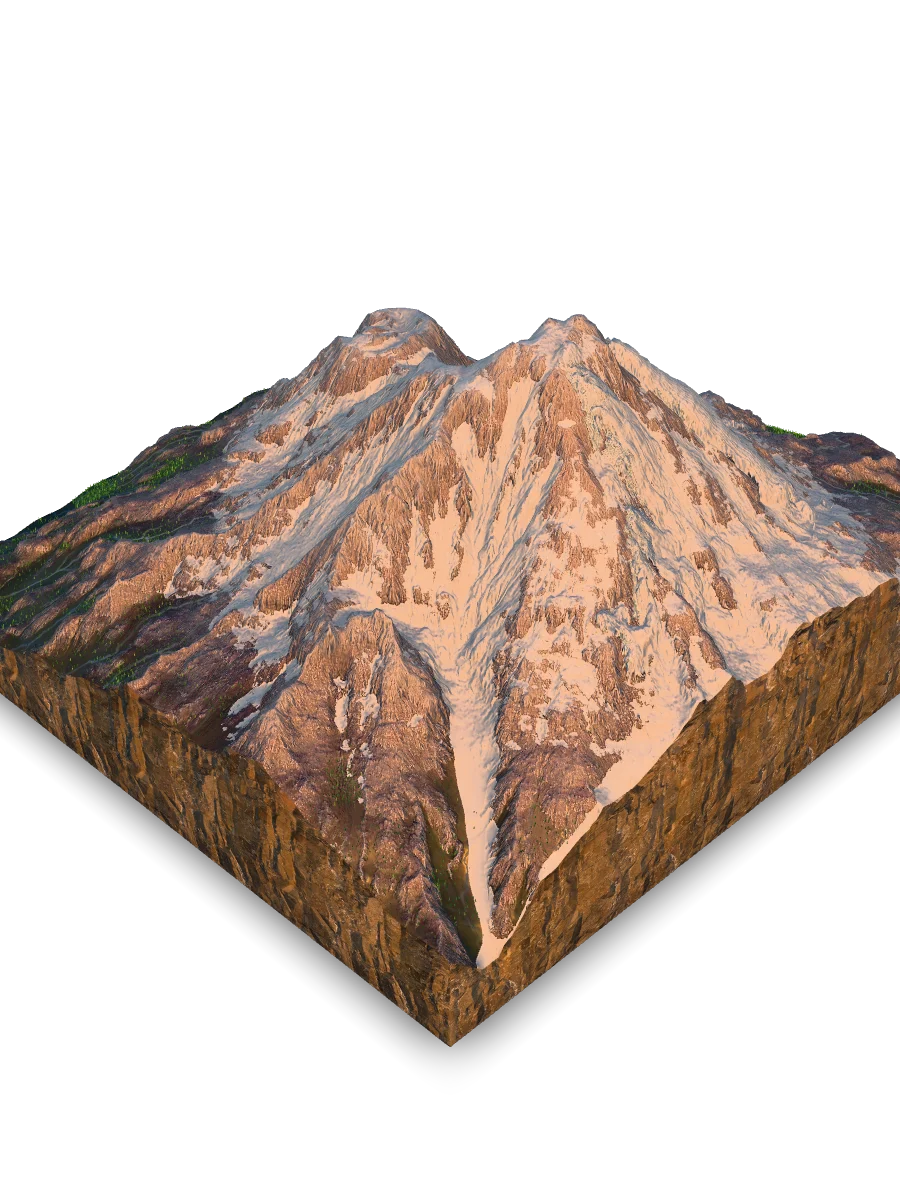
Mount Shasta Volcano, California
Explore Northern California's active compound stratovolcano in 3D, from its four overlapping cones and 4,317-meter summit to the glaciers carving its upper slopes.
Mount Shasta in Northern California: Two Worlds
Mount Shasta stands in the Cascade Range of Siskiyou County, about 65 km (40 mi) south of the Oregon-California border. It is a sacred landscape for several Indigenous peoples and, in modern New Age legends, the supposed home of Telos, a mystical city hidden within the mountain.
The mountain's introduction to the wider world was a gradual process, culminating in a legendary tale of survival.
Today, Mount Shasta exists in two parallel realities. It is a place where ancient mythology and modern legends collide.
Indigenous Sacred Landscape
Mount Shasta is central to the sacred geography and creation traditions of several local Indigenous communities, including Wintu and Pit River peoples. These distinct living traditions should not be reduced to a single universal mountain legend.
New Age Myth: Refuge of Lemuria
According to modern legends, a hidden underground city named Telos exists within the mountain. It is believed to be inhabited by advanced survivors from the mythical, sunken continent of Lemuria.
Mount Shasta's slopes can keep changing during long intervals without magmatic eruptions. The chart below records debris flows, a surface process distinct from a new eruption.
These debris flows can occur without a new magmatic eruption when meltwater mobilizes loose volcanic sediment. The 1900-1985 record documents slope change and debris-flow hazards; by itself, it is not evidence of present-day eruptive activity.
Data reflects the high-activity period of the 20th century. Frequency varies with climate cycles.
- 1900: 0
- 1920: 8
- 1940: 17
- 1960: 26
- 1985: 37
Shastina cone
The second-highest peak (3760 m) with a perfectly preserved crater, formed during a concentrated eruptive episode ~9,700 years ago, shortly before the ongoing growth of the modern Hotlum summit. On its slopes, volcanic ash created fertile soil, allowing the forest to rise to record heights. It acts as the "younger sister" of the giant, visually balancing its massive figure.
How Tall Is Mount Shasta? From Forests to Ice
Mount Shasta reaches 4,317 meters (14,163 feet) above sea level. Across the modeled upper mountain, more than 2,100 meters (7,000 feet) of vertical relief creates distinct ecosystem "floors," each with its own climate and residents.
How does life adapt to this rapid ascent? It follows the climate, forming four distinct zones that one can witness while climbing from the base to the summit.
This vertical organization is only part of the story. The other key factor is which way the slopes "face." The mountain's orientation creates two completely different worlds on its eastern and western sides.
The Northeast Sector
This side receives significantly less sun and acts as a "trap" for wind-blown snow. As a result, it is cold and wet, allowing giant glaciers like Hotlum and Wintun to exist. It is the most biologically poor zone.
The Southwest Sector
This side "faces" the sun. It is warmer, drier, and has much less ice cover. These conditions have allowed subalpine ecosystems, especially Foxtail Pine forests, to become much better developed on the rocky slopes.
What is the primary driver of this stark difference? An extreme climatic gradient. The temperature difference between the sheltered base and the wind-swept summit is colossal.
A comparison of average July temperatures reveals the chasm: while the base (in the town of Mount Shasta) experiences summer highs of +29°C (84°F), the summit on the same day barely climbs above +6°C (42,8°F).
Extreme Temperature Gradient (Average July High)
- Base (Mt. Shasta Town, ~1100 m): 29°C
- Summit (at ~4317 m): ~6°C
Hotlum peak
The youngest and highest point of the complex (4,317 m), formed by the extrusion of viscous lava. Lifeless cold reigns here, but it was the hot sulfur springs on this summit that once saved the life of naturalist John Muir. Mount Shasta is classified as active, not extinct, even though no magmatic eruption is known in about 3,200 years.
Is Mount Shasta Active? A Volcano Built Four Times
Yes. Mount Shasta is an active compound stratovolcano; its multi-millennial repose does not make it extinct. It was built above a subduction zone, where an oceanic tectonic plate descends beneath North America and helps feed the Cascade Volcanic Arc.
Evidence studied by the USGS places Mount Shasta's most recent magmatic eruption about 3,200 years ago. The older claim that it erupted in 1786 is no longer treated as a confirmed eruption.
How was Mount Shasta formed? It wasn't a single act of creation, but four major cone-building episodes stacked over hundreds of thousands of years. The modern profile is dominated by the two youngest centers, Shastina and Hotlum.
This building process continues, but today it faces two powerful, opposing forces. The mountain is simultaneously being built from within and carved from without. It is a contest between fire and ice.
The Force of Creation (Volcanism)
Deep beneath the mountain, magma is still active. At the summit of Hotlum Cone, this is visible as fumaroles hissing vents releasing steam and volcanic gases. The mountain is still "breathing" and capable of new eruptions, building itself up with thick, dacite lava.
The Force of Destruction (Erosion)
The mountain's slopes host massive glaciers, like Hotlum and Wintun. Meltwater from these glaciers mixes with loose volcanic rock, triggering frequent and powerful debris flows (lahars). These flows race downhill, carving deep canyons like scars into the volcano's flanks.
We see the mountain as it is now, but how long did nature build this "skyscraper"?
Mount Shasta is a young peak on an ancient foundation. The modern peak (Hotlum) is an infant compared to its older brother Sargent's.
Comparison of Cone Ages (years ago)
- Sargent's Ridge Cone: 250,000
- Misery Hill Cone: 130,000
- Shastina Cone: 9,800
- Hotlum Cone (Summit): 9,000
Mount Shasta Glaciers: Hotlum and Wintun
Hotlum and Wintun are two of Mount Shasta's five named glaciers; the others are Bolam, Konwakiton, and Whitney, which is the largest glacier in California. Hotlum occupies the northeast flank, while Wintun lies above the head of Ash Creek Canyon. Meltwater from the mountain's ice can mobilize loose volcanic sediment, generating debris flows that continue to reshape the slopes below.
The Giant's Living Legacy
Mount Shasta is not just a geological point on the map of California. It is an arena where the eternal fire of the depths meets the eternal ice of the heavens, creating conditions for unique life and human legends. From the tiny pika hiding in the rocks to the climber storming the summit, everyone here finds their limit and their revelation.
Mount Shasta Facts & Quick Reference
Where is Mount Shasta?
Mount Shasta volcano is in the Cascade Range of Northern California, in Siskiyou County about 65 km (40 mi) south of the Oregon border. It is distinct from the City of Mount Shasta, which lies southwest of the summit on the volcano's lower flank.
How tall is Mount Shasta?
Mount Shasta's summit elevation is 4,317 meters (14,163 feet) above sea level in the current USGS volcano profile. Its height makes it one of the highest volcanoes in the Cascade Range and the dominant peak of Northern California.
Is Mount Shasta active or dormant?
Mount Shasta is classified as an active stratovolcano. Its long interval without an eruption does not make it extinct. The USGS monitors the volcano because its geologically recent activity shows that future eruptions remain possible, although their timing cannot be predicted.
When did Mount Shasta last erupt?
The most recent confirmed magmatic eruption occurred about 3,200 years ago, according to current USGS evidence. A once-common claim that Mount Shasta erupted in 1786 was based on a distant historical observation and is now considered unconfirmed.
What type of volcano is Mount Shasta, and how was it formed?
Mount Shasta is a compound stratovolcano made mostly of andesite and dacite. Four major cone-building episodes constructed Sargents Ridge, Misery Hill, Shastina, and Hotlum around separate vents; repeated lava, ash, dome, and pyroclastic-flow deposits created the complex profile visible in 3D.
How many glaciers are on Mount Shasta?
The USGS lists five named Mount Shasta glaciers: Bolam, Hotlum, Konwakiton, Whitney, and Wintun. Whitney Glacier, between the Shastina and Hotlum cones, is the largest glacier in California.
Mnemosyne Protocol
The 3D scan captures the shape, but misses the soul.
Upload your memory to preserve the feeling of this place.