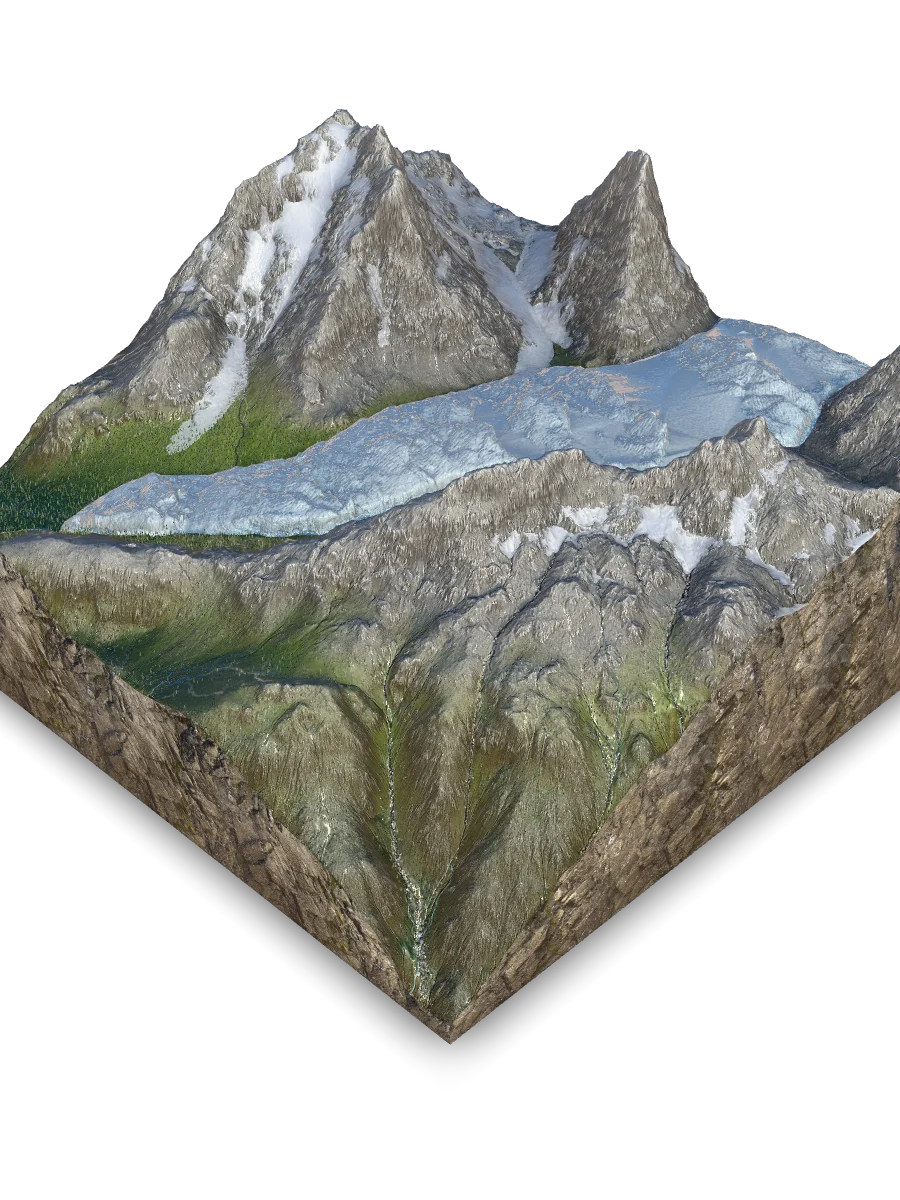
Aletsch Glacier, Switzerland
Explore the Great Aletsch Glacier (Grosser Aletschgletscher), the largest glacier in the Alps, on an interactive 3D map of its lower valley, moraines, forest, and retreating tongue.
Where Is Aletsch Glacier?
Aletsch Glacier is located in the Swiss Alps in the canton of Valais, Switzerland. It flows south from the Jungfrau region and lies within the Swiss Alps Jungfrau-Aletsch UNESCO World Heritage property.
More than just geology and biology, the glacier is a living archive. It holds stories of our ancestors' fears, traces of tragedies, and is a potent symbol for our time, reflecting the changing relationship between humans and nature.
Our perception of the glacier has changed dramatically in just a few centuries - from an object of superstitious fear to a subject of scientific study, and finally, to a symbol of planetary fragility.
Even the ice, which appears lifeless, has its own mythology and its own real, hidden ecosystem. Folklore and science offer two different views of the glacier's "inhabitants."
The Legend: Stollenwurm
Alpine folklore describes the Tatzelwurm or Stollenwurm ("tunnel worm") - a mythical serpent with a cat's head, living in the cracks and caves of the rocks. It is a reflection of a fear of the wild.
The Reality: Glacier Flea
There is real life on the ice surface. The Glacier Flea (Desoria saltans) is a tiny springtail that feeds on the dark "cryoconite" dust and pollen, perfectly adapted to the extreme cold.
This dark dust, cryoconite, isn't just dirt. It's a complex biosystem of mineral particles and microbes. It absorbs heat, accelerates melting, and forms the base of the glacier's food web.
Cryoconite is the "living dust" of the glacier. Composed of mineral particles, soot, microbes, and algae, it forms dark patches on the ice. These patches absorb solar heat, melting holes in the ice and creating micro-ponds where life, like the glacier flea, thrives.
Approximate Composition of Cryoconite
- Inorganic Matter (Dust): 90%
- Total Organic Matter (Living & Detritus): 10%
Geisshorn
This summit, bounding the glacier to the west, is a classic sharp ridge (arête). It forms the 'opposite bank' of this ice river, clearly demonstrating how glacial erosion carved the massive U-shaped valley between these high mountain walls.
Life on the Ledge
Despite the harsh conditions, the glacier and its surroundings support a surprisingly rich biodiversity. From centuries-old forests to microscopic creatures on the ice itself, life here is perfectly adapted to altitude and cold.
As the glacier retreats, it leaves behind a barren wasteland. But nature wastes no time. This process, called primary succession, shows how life slowly reclaims the territory from the ice.
Survival in this forest depends on unique partnerships. The most famous example is the symbiosis between the oldest tree and its most important helper.
The Ancient Pine
The Swiss Stone Pine (Pinus cembra) dominates the Aletsch Forest. Some trees here are 1,000 years old. They are hardy, but their seeds are heavy and cannot be spread by the wind.
The Forester Bird
The (Spotted) Nutcracker (Nucifraga caryocatactes) is in symbiosis with the pine. The bird feeds on the nuts and creates thousands of caches for winter. It forgets many, effectively planting new trees.
The landscape is divided into clear altitudinal zones, each a distinct world with its own inhabitants.
This chart shows the three main "floors" of the ecosystem. The Aletsch Forest (Subalpine) is unique because it is sheltered from the dry valley winds and receives moisture and cool air from the glacier, which acts as a giant air conditioner.
Altitudinal Zones
- Nival Zone (Permanent ice & rock): > 3000 m
- Alpine Zone (Meadows & shrubs): 2200 - 3000 m
- Subalpine Zone (Aletsch Forest): 1300 - 2200 m
Eggishorn Summit
This summit (2926 m) offers the best panorama of the entire glacier. Composed of Aar Massif gneiss, this rock was a nunatak - it stuck out of the ice during the glacial maximum, leaving its peak frost-shattered and sharp, not smooth.
Aletsch Glacier Retreat: The River of Ice
Aletsch Glacier is not a static landmark; it is a slowly flowing river of ice. Upstream of this 3D view, major ice streams converge at Konkordiaplatz, where the ice reaches roughly 800 to 900 meters thick before flowing south through the valley.
To understand this landscape, imagine a geological drama playing out over millions of years. The entire scene is the result of colliding continents, followed by the erosive power of ice.
The ice's movement created two vastly different types of terrain, still visible today. There is a sharp contrast between what the ice covered and what it did not.
Below the Ice Line
The slopes and bedrock that were once covered by ice (below ~2200 m) are smooth, polished, and rounded. The glacier acted as a giant piece of sandpaper, grinding away all sharp edges.
Above the Ice Line
The peaks that stuck out of the ice like islands (e.g., the Eggishorn) have sharp, jagged forms. Here, the only sculptor was frost, which shattered and cracked the rock.
The dominant modern change is retreat and ice loss. GLAMOS measurements record the terminus moving back about 3.39 km between 1870 and 2024, while annual changes vary with ice dynamics and the terrain at the glacier snout.
The cumulative GLAMOS series shows a long-term retreat of the glacier terminus. Terminus movement is not identical to annual ice melt, but the sustained retreat forms part of the wider loss of Alpine glacier ice under a warming climate.
Aletsch Glacier Retreat (Cumulative Terminus Change)
- 1870: 0 km (baseline)
- 1980: 1.79 km retreated
- 2000: 2.40 km retreated
- 2024: 3.39 km retreated
Glacier Snout (Gletschertor)
This is the epicenter of change. GLAMOS recorded a 64-meter retreat of the terminus from August 2023 to August 2024. The Massa River emerges from the snout carrying "glacial milk" - meltwater clouded by fine rock flour.
The Great Glacier
The Aletsch Glacier is not just a mass of ice sliding down a mountain. It is a geological engine that created the very landscape we stand on. It is a fragile oasis that engineers its own microclimate, allowing a thousand-year-old forest to survive. And it is a mirror, reflecting our own history - from superstitious fear to scientific curiosity, and finally, to an awareness of our responsibility.
Aletsch Glacier Facts & Quick Reference
Where is Aletsch Glacier located?
Aletsch Glacier is in the Swiss Alps in the canton of Valais, southwestern Switzerland. It begins below the high peaks of the Jungfrau region and flows south toward the Massa Gorge. The 3D map shows a lower section of the glacier and the surrounding Aletsch landscape.
How long is Aletsch Glacier?
The GLAMOS 2025 release labels Grosser Aletschgletscher at approximately 22.28 km. Glacier length changes over time as the terminus advances or retreats, which is why older publications and tourism sources may give different rounded figures.
Is Aletsch Glacier the largest glacier in the Alps?
Yes. The Aletsch Glacier, also called the Great Aletsch Glacier or Grosser Aletschgletscher, is the largest glacier in the Alps by area and ice volume and is also the range's longest glacier.
How far has Aletsch Glacier retreated?
The GLAMOS length-change series records about 3.39 km of cumulative terminus retreat between 1870 and August 2024. This is a change in the position of the glacier snout, not a direct measurement of annual melting or total ice-volume loss.
What is Konkordiaplatz?
Konkordiaplatz is the broad confluence high on the glacier where major ice streams from the Jungfrau region merge into the Great Aletsch Glacier. The combined ice is approximately 800 to 900 meters thick there before flowing south as one valley glacier.
Is Aletsch Glacier part of a UNESCO World Heritage site?
Aletsch Glacier lies within the Swiss Alps Jungfrau-Aletsch UNESCO World Heritage property. The mountain region was first inscribed in 2001 and later expanded; the glacier is one of its defining natural features, but it is not a separate UNESCO property by itself.
Mnemosyne Protocol
The 3D scan captures the shape, but misses the soul.
Upload your memory to preserve the feeling of this place.