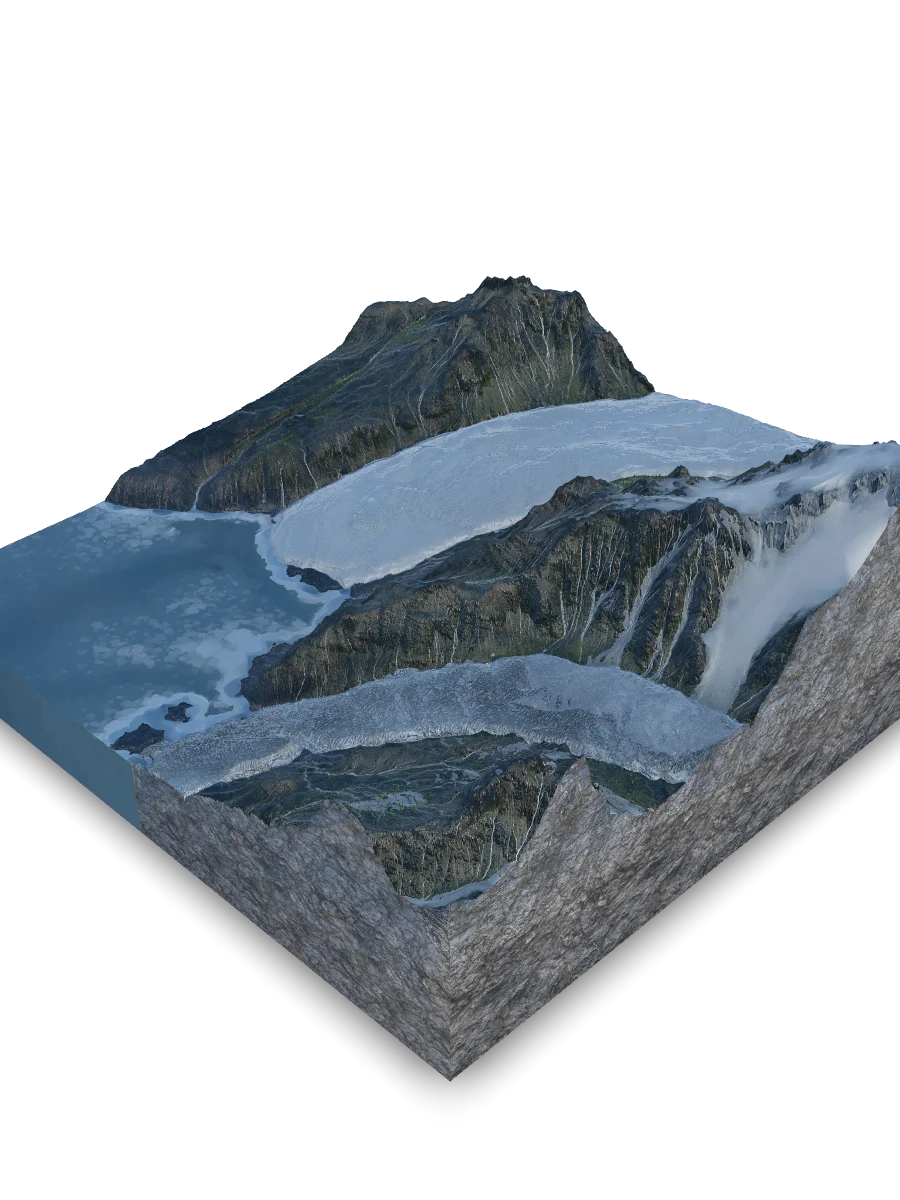
Skaftafell, Iceland: Glaciers, Svartifoss & Landscape
Explore Skaftafell in southeast Iceland as a 3D landscape, from the Skaftafellsjökull outlet glacier to Svartifoss and the surrounding terrain of Vatnajökull National Park.
Where Is Skaftafell?
Skaftafell is in Öræfi in southeast Iceland, on the southern side of the Vatnajökull ice cap. The area brings outlet glaciers, steep mountain slopes, river-cut valleys and vegetated lowlands together in one compact landscape.
Skaftafell and Vatnajökull National Park
Skaftafell was established as a separate national park in 1967. In 2008 it became part of the larger Vatnajökull National Park. The historic name "Skaftafell National Park" remains common, but today Skaftafell is an area within Vatnajökull National Park rather than a separate park.
Skaftafell's history is a dramatic saga of human resilience. Once a prosperous farming district known as the "Little District," it was completely wiped off the map by the 1362 catastrophe. Survivors named the scorched earth "Öræfi" - "The Wasteland."
The history of this place is a journey from total isolation and oblivion to the status of a world-famous destination.
Human perception of this harsh landscape has always been twofold, reflected in both modern science and ancient folklore.
Science: A Place of Hazard
Modern science views Skaftafell as a high-risk geological zone. The main threat is not the volcano, but an unstable rock mass of 60-100 million cubic meters on the Svínafellsheiði ridge, which is actively moving and could collapse at any moment.
Folklore: A Place of Protection
Ancient legends, in contrast, preserved an image of this place as a protector. The most famous myth tells of a benevolent troll woman who lived in a cave, befriended a local farmer, herded his sheep, and guarded his property from thieves.
Today, scientists constantly monitor the diverse risks to which this seemingly serene landscape is exposed.
The most immediate and high-level threat in the park is the giant landslide on the Svínafellsheiði ridge. The threat of jökulhlaups (floods) from an eruption is also high, while conventional earthquakes pose a lesser risk.
Geological Hazard Assessment
- Landslides (Svínafellsheiði): Very High
- Jökulhlaups (Floods): High
- Volcanic Activity: Medium
- Earthquakes: Low
Skaftafellsjökull: The Glacier at Skaftafell
Skaftafellsjökull, often called Skaftafell Glacier, is an outlet glacier of the Vatnajökull ice cap. It descends east of Skaftafellsheiði toward the lowlands, carrying ice and sediment through the valley visible in the 3D terrain.
As the glacier thins and retreats, its foreland exposes moraines, meltwater features and new ground where vegetation begins to establish. These traces make the changing relationship between the glacier and the Skaftafell landscape readable at a glance.
Svartifoss Waterfall in Skaftafell
Svartifoss is one of Skaftafell's defining landmarks. The waterfall crosses a cliff framed by dark, regular basalt columns, linking the area's volcanic bedrock to the water that continues to cut into it.
The columns formed about 300,000 years ago, when lava filled an older river channel and cooled slowly. As the rock contracted, it fractured into the geometric columns that now surround the waterfall.
Oasis at the Edge of the Ice
Despite the proximity of giant glaciers, the sheltered southern slopes of Skaftafell create a surprisingly mild "microclimate." This allows a diverse flora to thrive, rapidly colonizing the land uncovered daily by the retreating ice.
Life in Skaftafell is clearly organized by altitude, from dense forests in the valleys to an arctic desert near the volcano's summit.
The park's ecosystem exists in a constant tension between two opposing forces: the slow creation of life and its instantaneous destruction.
Creation (Primary Succession)
Glaciers retreat, exposing bare, lifeless rock. Mosses (especially Racomitrium) are the first to colonize it, slowly creating a thin layer of soil. This allows grasses, and then decades later, birch forests, to take root.
Destruction (Catastrophic Reset)
Volcanic eruptions and jökulhlaups (giant glacial floods) periodically "reset" this ecosystem. They wash away forests, sterilize the soil with ash, and throw the succession process back hundreds of years to the very beginning.
The key to life here is the relief. The mountains create an "orographic effect" that directly controls the distribution of moisture.
The orographic effect: mountains force moist air from the ocean to rise and cool. This causes precipitation to double at 600 m compared to the lowlands (100 m). This excess moisture feeds the glaciers above and creates rich peatlands on the middle slopes.
Orographic Effect (Precipitation)
- At Coast (100 m): 1230 mm
- At Height (600 m): 2460 mm
Svínafellsjökull Glacier
You'll almost certainly recognize this glacier: it's the stark "ice planet" from 'Interstellar' and the icy wastes from 'Game of Thrones'. Its dramatic and chaotic surface is not a special effect. It is the direct result of an overhanging geological threat. Rockfalls constantly break free from the cliffs of the unstable Svínafellsheiði ridge, covering the clean ice in a thick "armor" of dark debris and volcanic ash.
How Glaciers Shaped the Skaftafell Landscape
Skaftafell lies where the Vatnajökull ice cap, steep volcanic mountains and meltwater plains meet. Glaciers cut valleys into rock built by Öræfajökull, while meltwater carries sediment toward the lowlands. The resulting terrain records the combined work of ice, water, volcanism and gravity.
The Skaftafell landscape is not static. It is being created right now in a four-step process where ice, fire, and gravity constantly reshape the terrain.
The park's two main glaciers, Svínafellsjökull and Skaftafellsjökull, exhibit completely different characters and behaviors.
Svínafellsjökull Glacier
Its surface is covered in a thick layer of dark debris and ash, brought down from the surrounding slopes by landslides. It retreats chaotically, leaving behind high, messy push moraines (ridges) up to 60 meters tall.
Skaftafellsjökull Glacier
It has very little surface debris. Its retreat is smoother and faster, leaving only low concentric ridges of lodgement till, resembling ripples on water.
The park's geological record shows this landscape was formed over millions of years, cycling through warm periods and ice ages.
This chart shows the stark contrast in moraine (glacial debris) height left by the two glaciers. Svínafellsjökull, fed by landslides, left massive 60-meter ramparts, while the 'clean' Skaftafellsjökull left only low ridges.
Moraine Height Contrast
- Svínafellsjökull Glacier: 60 m
- Skaftafellsjökull Glacier: 3 m
Svínafellsheiði Ridge
This viewpoint offers the park's most dramatic and unsettling insight. The unique thing about this spot is that you are standing on top of the very same giant, unstable block of rock (a 60-100 million cubic meter mass) that threatens the glacier below. You are literally on a "living" landslide, centimeter by centimeter, creeping into the valley.
Skaftafell in 3D
This 3D map brings Skaftafell's features into one spatial view: the outlet-glacier valleys descending from Vatnajökull, the ridges between them, and the lower landscape around Svartifoss. A retreating glacier exposes new land, which is colonized by mosses and can eventually support new vegetation.
For humanity, this place has become a symbol. It is a natural laboratory for studying climate change, a filming location for other worlds ("Interstellar," "Game of Thrones"), and, most importantly, a tragic and inspiring story of resilience.
Skaftafell, Skaftafellsjökull & Svartifoss Facts
Where is Skaftafell?
Skaftafell is in Öræfi in southeast Iceland, south of the Vatnajökull ice cap. It is now an area within Vatnajökull National Park.
Is Skaftafell a national park?
Skaftafell was established as its own national park in 1967. Since 2008 it has been part of Vatnajökull National Park, so "Skaftafell National Park" is a historic and still commonly used name rather than its current status as a separate park.
What glacier is at Skaftafell?
Skaftafellsjökull is the outlet glacier most directly associated with Skaftafell. The neighboring Svínafellsjökull is a separate outlet glacier and is also visible in this 3D landscape.
What is Skaftafellsjökull?
Skaftafellsjökull is an outlet glacier of the Vatnajökull ice cap. It descends east of Skaftafellsheiði, and its foreland preserves moraines, meltwater features and newly exposed ground left by the glacier's retreat.
What is Svartifoss?
Svartifoss is a waterfall in Skaftafell known for the dark basalt columns around it. Those columns formed when lava filled an old river channel about 300,000 years ago, cooled slowly and fractured as it contracted.
Mnemosyne Protocol
The 3D scan captures the shape, but misses the soul.
Upload your memory to preserve the feeling of this place.