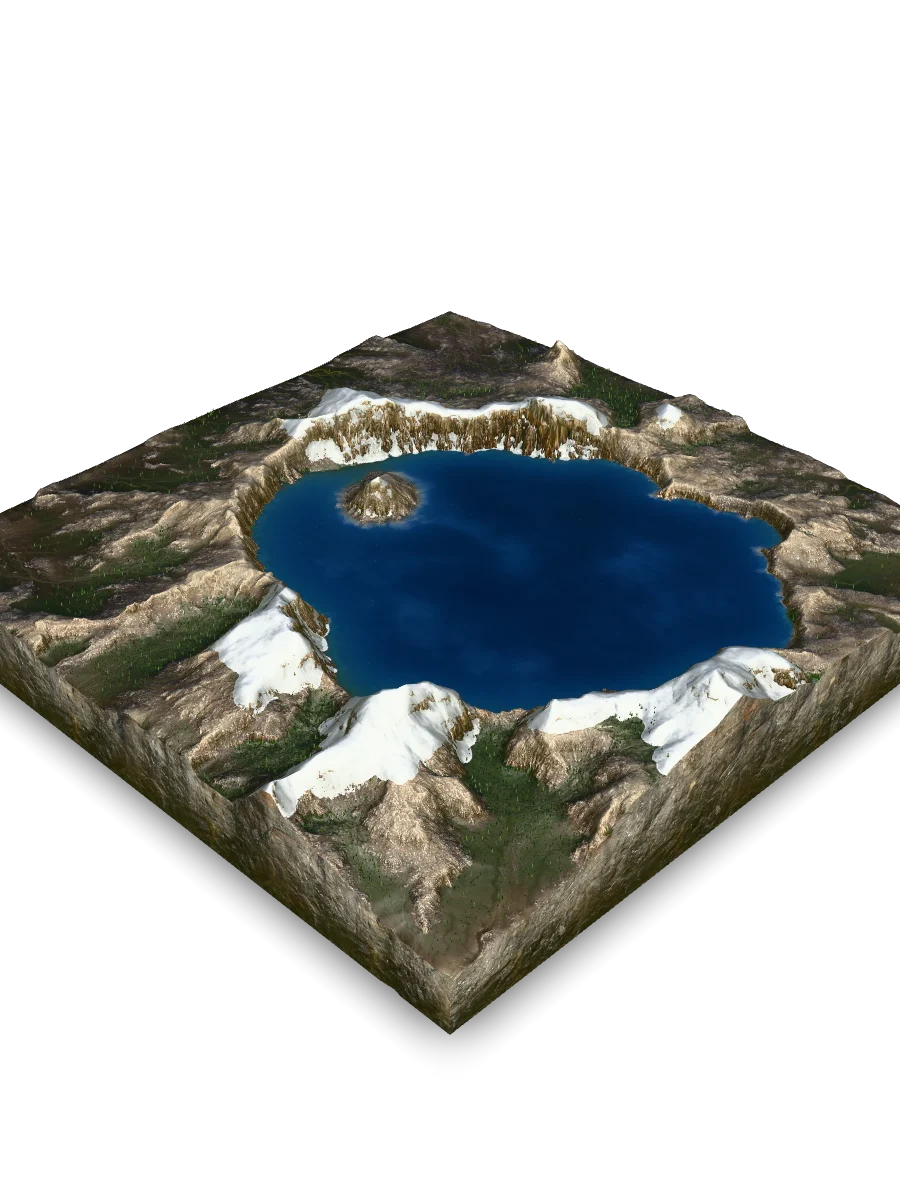
Crater Lake, Oregon
Explore the deepest lake in the United States in 3D, from Mount Mazama's 7,700-year-old caldera to Wizard Island and the lake's 594-meter depths.
How Deep Is Crater Lake?
Crater Lake lies in southern Oregon. A USGS bathymetric survey measured a maximum depth of 594 meters (1,949 feet), making it the deepest lake in the United States. Its blue water partly fills the caldera left by the collapse of Mount Mazama.
Science sees a closed hydrosystem; legend sees a prison for a fallen god. Both agree: this place commands a silence unlike anywhere else on Earth.
Long before geologists arrived, the Klamath people knew exactly what happened here. How did they preserve the truth?
Is this water just rain, or is it something more alien?
WHY IS CRATER LAKE SO BLUE?
The lake's exceptional depth, purity, and clarity allow sunlight to penetrate far into the water. Longer wavelengths are absorbed while blue light is scattered back, producing its intense color.
WHERE DOES CRATER LAKE'S WATER COME FROM?
No rivers flow in or out. Rain and snow supply the lake, while evaporation and underground seepage keep its level in balance.
The surface sparkles in the summer sun, but does that warmth reach the secrets hidden in the dark?
While the surface invites interaction, the deep water remains in eternal, near-freezing stasis, unaffected by the seasons above.
Thermal Paradox
- Summer Surface: 16 °C
- Deep Water: 3.5 °C
Wizard Island in Crater Lake
Wizard Island is a volcanic cinder cone that began growing after Mount Mazama collapsed, while rain and snow were still filling the caldera. It rises about 234 meters above the lake, but most of the post-caldera volcano remains hidden below the water.
Life in the Concrete Snow
This isn’t just winter; it is a crushing weight. Life here clings to existence under “Cascades Concrete”—a heavy snowpack that buries the world nine months a year.
How does a forest survive when it spends most of its life underwater—or rather, under-snow?
Is the forest thriving, or is it a graveyard of preserved memories?
THE PIONEERS
Lodgepole Pines are the risk-takers. They colonize nutrient-poor pumice dust where no other tree can grow, their cones waiting for fire to release seeds.
THE GHOSTS
On the rim, “snags” stand guard. These dead trees don’t rot; cold, dry air mummifies them into silver sculptures that stand for decades.
We talk about heavy snow, but do the numbers truly capture the crushing reality of a winter here?
With an average accumulation that could bury a four-story building, the snow here is a geological force in its own right.
The Weight of Winter
- Average Snowfall: 13.2 m
- Record Snowfall: 22.0 m
Kerr Notch
A glacial valley sliced in half by the catastrophe. Hanging in mid-air over the abyss, this “beheaded” canyon is the fossilized footprint of an ice river that flowed here long before the mountain died.
How Was Crater Lake Formed?
Crater Lake formed about 7,700 years ago during the climactic eruption and collapse of Mount Mazama, a complex Cascade volcano in southern Oregon. After roughly 50 cubic kilometers of magma erupted, the summit lost support and subsided above the partly emptied reservoir, creating an 8-by-10-kilometer caldera that later filled with rain and snow.
How does a titan disappear? It didn’t explode outward like a bomb; it was sabotaged from within.
Did this event destroy everything, or did it leave clues behind?
MOUNT MAZAMA'S SURVIVING SLOPES
U-shaped valleys—like Kerr Notch—hang mid-air on the cliff edge. These “beheaded” glacial paths prove ice rivers flowed here long before the mountain fell.
THE SCARS
The “Devil’s Backbone” stands tall—a vertical wall of hardened lava. Once magma filling a deep fracture, erosion has stripped the soft rock to reveal this skeletal rib.
We see the rim today, but how much of the original sky-piercing giant was lost to the catastrophe?
The phantom peak of Mount Mazama stood over a kilometer higher than the current rim, a massive structure now replaced by void and water.
The Great Beheading: Elevation Loss
- Ancient Mount Mazama: 3700 m
- Current Peak (Hillman): 2484 m
- Lake Surface: 1883 m
Hillman Peak
The rim’s highest sentinel at 2,484 meters. Once a mere side-vent on the flanks of the giant, this spire survived the collapse to stand as the jagged crown of the new landscape.
Echoes of the Cataclysm
Mount Mazama didn’t just die; it metamorphosed. What was once a fortress of fire is now a sanctuary of water. The jagged scars of the collapse are softened by relentless snow, the violent history hushed by the depth of the blue. Here, Earth’s most destructive power created its most fragile beauty—a reminder that in nature, every end is a quiet beginning.
Crater Lake Facts & Quick Reference
How was Crater Lake formed?
About 7,700 years ago, Mount Mazama's climactic eruption expelled roughly 50 cubic kilometers of magma. As magma withdrew from the reservoir, the unsupported summit collapsed and formed an 8-by-10-kilometer caldera. Rain and snow later filled part of this basin, creating Crater Lake.
How deep is Crater Lake, and is it the deepest lake in the United States?
The USGS measured a maximum water depth of 594 meters (1,949 feet), making Crater Lake the deepest lake in the United States. The underlying caldera is deeper still: sediment, landslide debris, and post-caldera volcanoes occupy part of the original basin below the lake floor.
How did Wizard Island form?
Wizard Island grew from post-caldera eruptions after Mount Mazama collapsed. Its cinder cone rose from the caldera floor while Crater Lake was filling, and only the upper portion now stands above the water. Other post-caldera volcanic features remain submerged.
Why is Crater Lake so blue?
Crater Lake's great depth and exceptionally clear, pure water shape the way sunlight moves through it. The water absorbs longer wavelengths and scatters blue light back toward the surface. Rain and snow are its only water sources; there are no river inlets or outlets.
Is Crater Lake a volcano?
No. Crater Lake is a lake in southern Oregon that partly fills a volcanic caldera. The caldera belongs to Mount Mazama, the Cascade volcano whose summit collapsed during the climactic eruption about 7,700 years ago. Wizard Island is a younger volcanic cone inside that caldera.
Mnemosyne Protocol
The 3D scan captures the shape, but misses the soul.
Upload your memory to preserve the feeling of this place.