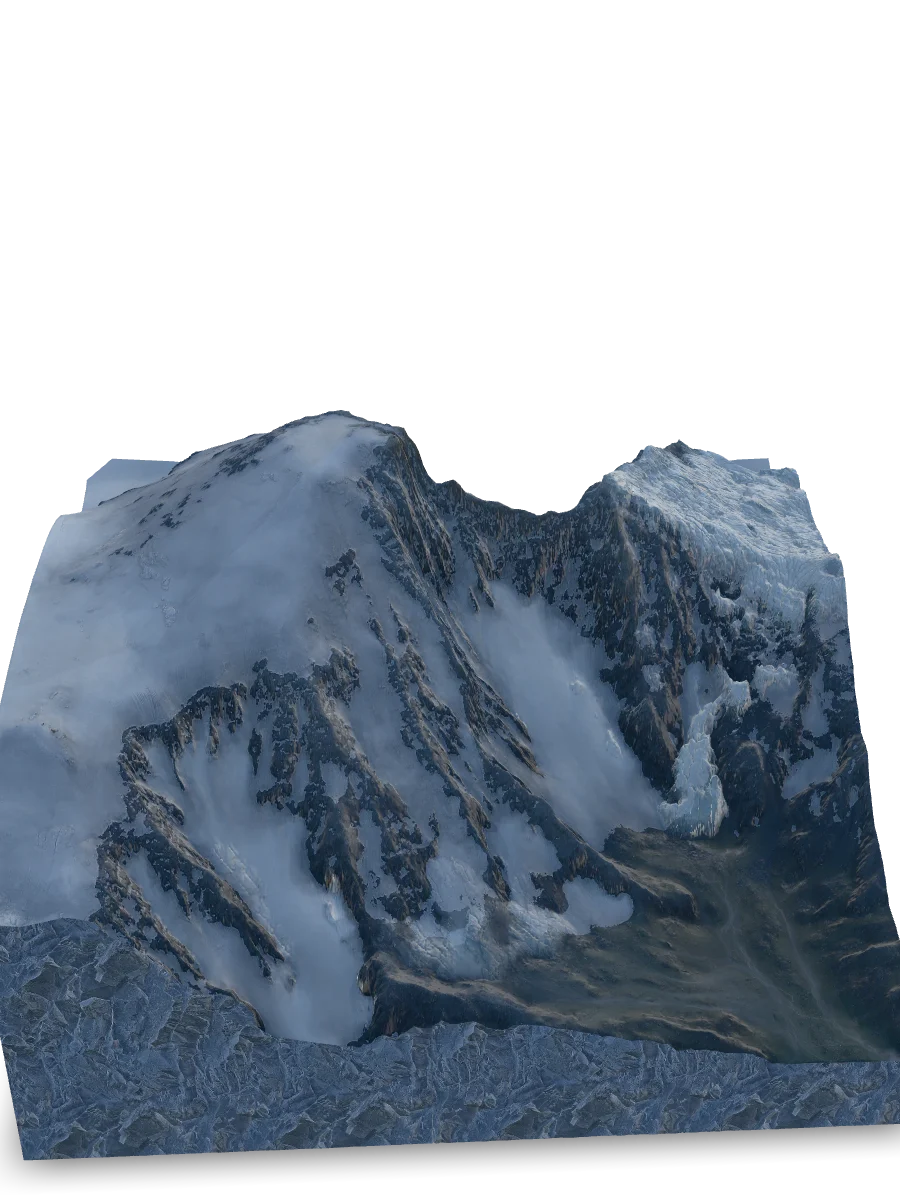
Shape
Shield volcanoes typically have low-angle flanks and a broad, gently domed profile.
Explore Mount Sanford, a shield volcano in United States, through a detailed 3D terrain model and learn how shield volcanoes form, erupt, and change over time.
IDENTITY / LOCATION
Mount Sanford is a shield volcano in United States.
FORM / GROWTH
Shield volcanoes are broad volcanic edifices built mainly by repeated lava flows that spread across wide areas.
Shield volcanoes typically have low-angle flanks and a broad, gently domed profile.
Repeated eruptions commonly add lava from summit or flank vents, widening and raising the edifice.
Shield volcanoes can produce lava flows and lava fountains. Explosive episodes are also possible, so a shield shape does not guarantee a quiet eruption.
Over time: Later lava flows can cover older surfaces, widen the flanks or build new vent areas; erosion can reshape the edifice.
ERUPTION MATERIAL
Shield volcano eruptions can release flowing lava, spatter and other tephra.
Lava is magma that has reached the surface. A lava flow is molten rock moving away from a vent before it cools and solidifies.
Spatter is molten lava thrown into the air that is still soft when it lands, so pieces can flatten or stick together.
Tephra is fragmented material ejected into the air during an eruption; it ranges from fine ash to much larger pieces.
BETWEEN ERUPTIONS
Between eruptions, some volcanic systems can continue to transfer heat, fluids and gases beneath the surface.
Volcanic gases can separate from magma and move through fractures, vents or permeable rock.
Where heat, groundwater and permeable rock meet, water can circulate and warm. Hot springs, steaming ground or fumaroles may appear where conditions allow.
Small earthquakes can accompany rock fracturing or the underground movement of magma and fluids.
Changing pressure from magma or fluids can raise, lower or shift parts of the ground surface.
These processes can occur without an eruption following.
VOLCANO MONITORING
Seismometers record earthquakes and other vibrations. Their location, depth and frequency can help reveal processes underground.
GPS instruments and satellite radar can measure small changes in the position and shape of the ground.
Scientists can measure gases such as sulfur dioxide and carbon dioxide to investigate changes in a volcanic system.
Thermal cameras and satellite sensors can detect changes in surface temperature.
A single signal can have several causes, so volcanologists compare multiple measurements before interpreting changes.
The 3D scan captures the shape, but misses the soul.
Upload your memory to preserve the feeling of this place.